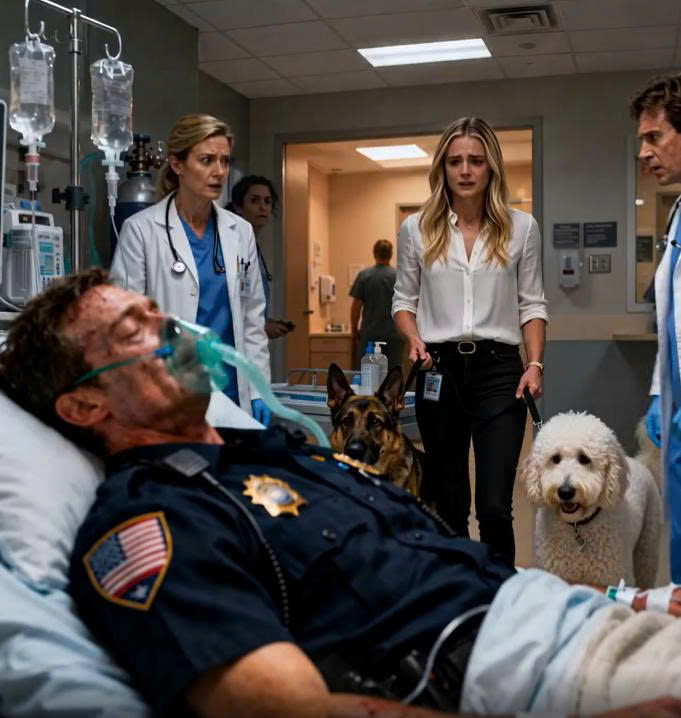
By the time twenty doctors stood around Officer Ethan Blackwood’s hospital bed, the dog in the corner had already stopped believing in them.
Max had been motionless for nearly two days, folded against the wall beneath the harsh fluorescent light of Massachusetts General’s intensive care unit, his black-and-tan body pressed into the smallest shape a ninety-pound German Shepherd could manage. He had refused water until Patrick Wilson poured it into his hand. He had refused food entirely. Nurses had stepped around him with the nervous respect people give loaded weapons and grieving relatives.
Every few minutes, Max lifted his head to look at the bed.
Every few minutes, the machines answered for Ethan.
Beep.
Pause.
Beep.
Outside the windows, Boston disappeared beneath a summer storm. Rain struck the glass in wild silver sheets, and thunder rolled over the city like artillery moving through clouds. In the bed, Ethan Blackwood lay pale and still, surrounded by tubes, wires, pumps, monitors, and the defeated brilliance of modern medicine.
Dr. Rebecca Thompson stood at the foot of the bed with her arms crossed over her white coat. She was fifty years old, calm in every crisis, precise in every sentence, and tonight her face looked like something had cracked behind it.
“We’ve run the panels twice,” said Dr. Wilson from neurology. “No stroke. No aneurysm. No obvious infection. EEG patterns suggest toxic exposure, but nothing matches.”
“Cardiac markers are worsening,” another doctor said.
“Liver enzymes climbing.”
“Respiratory irregularity increasing.”
“Pupillary response inconsistent.”
Patrick Wilson heard all of it and none of it.
He stood near the head of the bed, one hand on the railing, still in his Boston Police uniform though the sleeves were wrinkled and the collar had gone soft with sweat. He was thirty-five, broad-faced, open-hearted, a man whose emotions had never learned to stand at attention. His eyes were red from sleeplessness. His phone had buzzed all night with messages from officers, from his wife Jennifer, from his daughters asking whether Uncle Ethan and Max were coming to Sunday dinner.
He had not answered the girls.
What could he say?
Uncle Ethan is dying, and no one knows why.
Dr. Thompson looked toward the monitors.
“His systems are shutting down.”
The room went quiet.
The kind of quiet that comes when everyone understands a sentence before it is spoken.
An older doctor stood apart from the circle, his silver hair uncombed, his coat hanging open over a faded plaid shirt. Dr. William Harper was not officially on the case. At seventy, retired from military medicine and volunteering at Mass General when bureaucracy allowed it, he belonged to another era of doctoring, one that had seen jungle fever, battlefield amputations, improvised transfusions, and soldiers dying with letters taped inside their helmets.
He stared not at Ethan, but at Max.
The dog’s ears had moved.
Only slightly.
A flick.
Then another.
Max lifted his head.
His nose twitched.
“Max?” Patrick whispered.
The dog rose.
The movement drew every eye. For two days, Max had been a monument. Now his body was tense, focused, alive with terrible purpose. He moved past a nurse, past an IV stand, past Dr. Thompson’s startled hand, and went directly to the small closet where Ethan’s personal effects had been placed.
“Stop him,” a resident said.
Patrick shook his head.
“No. Wait.”
Max pawed at the closet door.
Patrick opened it.
The dog shoved his muzzle inside, seized Ethan’s duffel bag in his teeth, and dragged it into the room. The canvas scraped across the tile. Max put one paw on it and worked the zipper with a precision that made the nurses step back.
Inside were ordinary things. A change of clothes. A department sweatshirt. A paperback novel Ethan had never finished. A small toiletry bag. A folded photograph of Patrick’s daughters sitting on Max’s back in the yard.
Max nosed past all of it.
Then he froze.
Slowly, delicately, he withdrew something small and metallic in his mouth.
He placed it on the floor.
A brass shell casing.
Patrick stared.
“That wasn’t in there before.”
Dr. Harper crouched, his old knees popping softly. He did not touch the object. He leaned close, squinting through his glasses.
The color left his face.
“What is it?” Dr. Thompson asked.
Harper’s voice dropped to a whisper.
“That’s not just a shell casing.”
Thunder cracked over the hospital.
Max backed away from the casing and returned to Ethan’s bedside. He placed his head beneath Ethan’s limp hand as if he had done all he could and was now asking the man to wake.
Ethan did not move.
The monitor beeped again.
Slower this time.
Patrick looked from the shell casing to Dr. Harper.
“What did he find?”
Harper did not answer immediately.
He was staring at the brass as if it had followed him home from a war everyone else thought had ended.
“Get a hazmat kit,” he said. “Secure that casing. No one touches it with bare hands.”
Dr. Thompson’s brows drew together.
“Dr. Harper—”
“Now, Rebecca.”
Something in the old doctor’s voice cut through protocol.
The room shifted.
Nurses moved. A security officer was called. Patrick stepped closer to Max, his heart beating hard against his ribs.
The German Shepherd looked up at him.
Those dark eyes held exhaustion, pain, urgency, and something Patrick could not name.
Ethan had once told him, after a bad night when Max had woken him from a nightmare, “People think dogs don’t remember war. They do. They just don’t talk about it.”
Now Patrick wondered what Max had remembered.
And what he had smelled.
## Chapter Two: Before the Poison
Ethan Blackwood had never been easy to know.
He was respected in the Boston Police Department, which was not the same as being understood. Officers trusted him in dangerous calls. Supervisors praised his reports. Recruits lowered their voices around him because combat veterans with square jaws and quiet eyes tend to collect myths the way old churches collect dust.
At thirty-eight, Ethan looked older from a distance and younger when he smiled, which happened rarely enough to startle people. He carried himself with the economy of a man who had learned that unnecessary motion attracted bullets. He drank coffee black, kept his apartment spotless, and checked exits in restaurants even when pretending not to.
Only Max could make him look unguarded.
Max had come into his life after Afghanistan, though the story Ethan told was simple enough to hide a hundred ghosts.
“His handler didn’t make it,” he once told Patrick. “Max needed someone. So did I.”
Patrick had not pushed.
That was the foundation of their friendship: Patrick talked too much, Ethan talked too little, and between them they somehow built a language.
They had been partners for three years in South Boston. Patrick had a wife, Jennifer, two little girls, a mortgage, a lawn mower that refused to start, and a gift for saying the thing everyone else was too embarrassed to say. Ethan had Max, a one-bedroom apartment in Dorchester, a row of medals in a shadow box, and a freezer full of meals Jennifer sent home with him because she claimed he was “nutritionally unsupervised.”