On the night Chloe Jensen lost the use of her legs, she had danced so beautifully that the room forgot to breathe.
That was what the director told her afterward, his hands still trembling as he held her face between them, kissing one cheek and then the other beneath the hot white stage lights.
“My God, Chloe,” he whispered. “Do you understand what you just did?”
She laughed because she did not. Not fully. Not yet.
Her chest was still rising and falling from the final act of Swan Lake. Sweat cooled along her spine beneath the pale rehearsal bodice. Her feet ached in the familiar way that had always felt less like pain than proof. Around her, dancers were clapping, some with real joy and some with the careful politeness of people realizing history had moved past them.
At twenty-two, Chloe Jensen was no longer just the promising girl with the impossible extension and the haunted eyes.
She was going to be Odette.
Not understudy. Not alternate. Not the young dancer the donors smiled at because tragedy made beauty more marketable.
Principal.
The youngest in the Pacific Northwest Ballet’s recent history.
Her body still hummed with the music. Even after the orchestra rehearsal ended and the theater emptied into the wet Seattle night, Tchaikovsky stayed inside her ribs. She could feel the swans in her shoulders, the grief in her wrists, the fragile terror of a woman trapped by someone else’s cruelty.
“That was the one,” Marisol said, appearing beside her at the dressing room mirror.
Chloe was pulling pins from her hair, dark strands falling around her flushed face.
“The one what?”
“The rehearsal people talk about after you become insufferably famous.”
Chloe smiled, but it faltered when her phone lit up.
A photo filled the screen before she answered: her brother Caleb in desert camouflage, one arm slung around the neck of a black German Shepherd who looked less like a dog than a shadow with teeth.
Mrs. Garrett was calling from Chloe’s apartment upstairs from her own.
Chloe answered on speaker while untying her ribbons.
“Please tell me he hasn’t eaten my couch.”
Mrs. Garrett’s elderly voice crackled through the phone. “He is sitting by the front door like a statue. Hasn’t moved in an hour.”
Chloe’s smile softened.
“Tell him I’m coming home.”
“I did. He blinked at me like I was incompetent.”
“That means he likes you.”
“Then I shudder to think what disapproval looks like.”
Chloe laughed.
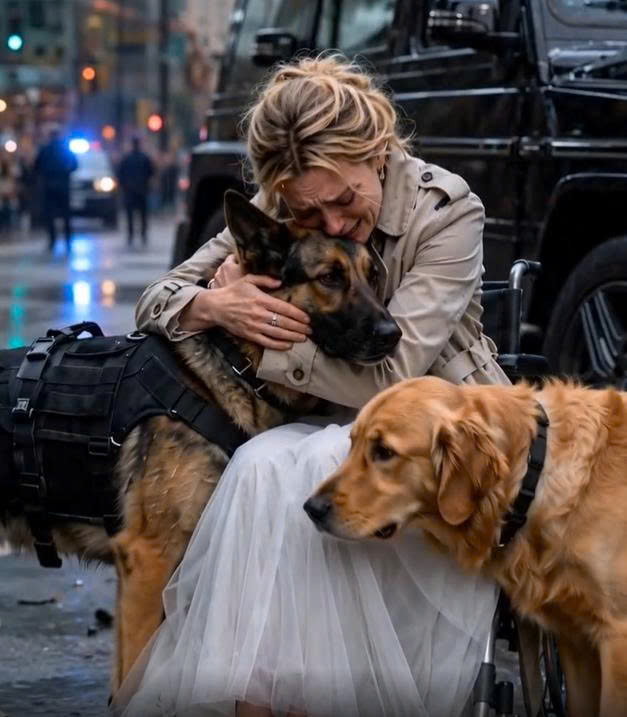
Across the dressing room, Marisol watched her. Everyone at the company knew about Caleb in the way people knew things they were too polite to mention. Killed eight months earlier during a military police operation overseas. Older brother. Only family. Left behind one folded flag, one olive-green trunk, and one retired military K9 named Brutus.
To most people, Brutus was terrifying.
To Chloe, he was home.
He slept at the foot of her bed. He followed her from room to room with quiet patience. He woke her before nightmares swallowed her whole. He still sometimes went to Caleb’s old jacket hanging by the door and pressed his nose into the sleeve.
Chloe understood that.
Some losses had scent.
“I’ll be there in ten,” Chloe told Mrs. Garrett. “There’s a steak in the fridge with his name on it.”
“He knows.”
“He always knows.”
The rain had thickened by the time Chloe stepped out of the theater. Seattle in November carried a particular kind of cold, one that slipped past fabric and found bone. Streetlights shimmered on wet pavement. Taxis hissed along the curb. Somewhere down the block, a man played a saxophone under an awning, the notes bending soft and lonely through the storm.
Chloe pulled her trench coat tight and hurried toward her old Honda Civic.
Her body was tired, but her mind would not settle. She replayed the rehearsal in fragments as she drove out of the garage: the hush after her entrance, the snap of her fouettés, the director’s face, the stage manager wiping tears with the back of one hand.
For the first time since Caleb died, the future did not look like a hallway closing in.
She called Mrs. Garrett again through the car’s Bluetooth.
“Update?”
“He’s still at the door.”
“Of course he is.”
“I think he heard your car from eight blocks away.”
“I’m not eight blocks away.”
“He disagrees.”
Chloe turned onto Fourth Avenue, laughing softly.
The light ahead turned green.
Solid. Undeniable. Reflected bright across the slick black road.
She entered the intersection.
The headlights came from her left like a second sunrise.
Too fast.
Too close.
For one suspended instant, Chloe saw the other driver clearly through the rain-streaked glass: a young man behind the wheel of a matte black Mercedes G-Wagon, laughing, mouth open, one hand loose on the wheel, his face lit blue-white by a phone screen in the passenger’s hand.
Then there was no time.
The impact struck her door with a sound so enormous it erased the world.
Metal folded inward. Glass burst into glittering fragments. Her body was thrown sideways, held and broken by the seat belt at once. The car spun across the intersection, tires shrieking, the city becoming streaks of light and rain.
Classical music still played from the radio.
That was what she remembered later.
Not the screaming.
Not the smell of gasoline.
Not the taste of blood.
Music.
A violin line trembling beneath the sound of a woman somewhere shouting, “Call 911!”
Chloe tried to move.
Her left hand twitched.
Her right cheek was pressed against something wet.
She thought of Brutus waiting by the door.
Then the world narrowed to a tunnel of rain and red light.
Her last clear thought was absurdly calm.
Caleb, I’m scared.
Then darkness took her.
When Chloe opened her eyes, the ceiling was white.
Not theater white. Not the warm painted white of backstage walls. Hospital white. Sterile and absolute.
A machine beeped beside her. Something tugged at her arm. Her throat burned. Her mouth tasted like plastic.
A woman in blue scrubs leaned into view.
“Chloe? Can you hear me?”
Chloe tried to answer. Only a rasp came out.
“You’re at Seattle General,” the nurse said. “You were in an accident. You’re safe.”
Safe.
The word floated above her, useless.
Chloe tried to sit up.
Pain flashed across her ribs and spine so violently that her vision blurred. She gasped and instinctively tried to pull her knees toward her chest.
Nothing happened.
She tried again.
Her upper body trembled with effort.
Nothing.
Panic arrived before understanding.
“My legs,” she whispered.
The nurse’s face changed.
That was how Chloe knew something terrible had already happened and everyone else had been waiting for her to catch up.
A doctor came in. Dr. Iris Maddox, she said. Trauma surgery. Calm voice. Kind eyes. The kind of expression that had practiced carrying impossible news.
Chloe stared at her mouth because looking into her eyes felt too intimate.
“Chloe,” Dr. Maddox said, “the collision caused catastrophic trauma to your spine. Your L1 and L2 vertebrae were shattered. We stabilized what we could during surgery, but the spinal cord was severed.”
Chloe heard the words.
She understood each one separately.
Together, they refused to form meaning.
“I have a show,” Chloe said.
The doctor went still.
“It opens Friday.”
No one spoke.
Chloe looked down at the blanket covering her lower body.
“Move,” she whispered to her feet.
They did not.
“Move.”
The machine beeped.
A tear slid into her hairline.
Dr. Maddox stepped closer.
“I am so sorry.”
Chloe shook her head. It was a tiny movement, more instinct than denial.
“No.”
“I’m so sorry, Chloe.”
“No.”
“You are paralyzed from the waist down.”
The sentence entered the room and took everything with it.
Not just walking.
Not just dancing.
Everything.
The studio mirrors. The rosin box. The smell of leather and sweat. Caleb picking her up after late rehearsals with Brutus sitting proudly in the backseat. Her mother’s old recordings. Her father’s hands clapping too loudly before he got sick. Every version of herself that had existed inside motion.