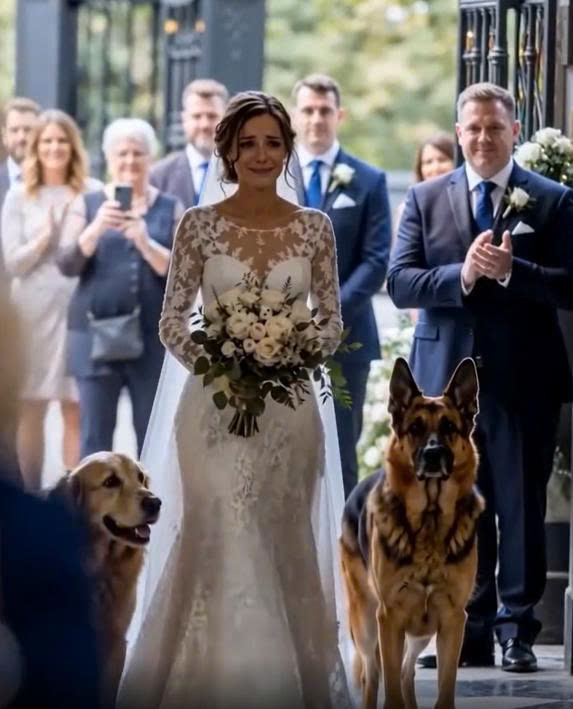
When Father Thomas asked who was giving me away, fifty-three people turned toward the back of the church and found no father standing there.
No uncle.
No brother.
No older cousin in a rented suit, no family friend with damp eyes, no trembling hand ready to place mine into Daniel’s.
Just two dogs.
Sammy sat on my left, golden and broad and smiling as if this were all perfectly reasonable. His white muzzle made him look wiser than he had any right to look, considering he had eaten half a stick of butter that morning and tried to hide the evidence by sitting on the wrapper.
Rex sat on my right, a German Shepherd with one ear that still didn’t stand straight and eyes so serious they could silence a room faster than any priest. He wore a dark blue ribbon tied around his collar because he had refused flowers with the quiet disgust of a retired judge.
I held both their leashes in my hands.
My wedding dress brushed the old wooden floor of St. Margaret’s Church. My veil trembled slightly in the draft that always slipped beneath the side doors, carrying in the scent of wet leaves, candle wax, and the forest beyond the cemetery. Outside, October rain tapped gently at the stained-glass windows. Inside, every pew had gone silent.
Daniel stood at the altar.
He was smiling, but there were tears in his eyes.
That was Daniel. He did not hide tenderness well, and I loved him for it.
Father Thomas cleared his throat, though he didn’t need to. The church was so quiet I could hear Sammy’s breathing and the tiny click of Rex’s nails against the floor. Somewhere in the third pew, Sister Mary Ann made a sound that was either a sob or an attempt not to sob. Knowing her, it was both.
Father Thomas asked again, softer this time.
“Who presents this woman to be married?”
It was a traditional question.
A simple one.
At most weddings, it belonged to fathers and daughters, to old customs dressed up as sentiment, to men who walked down aisles trying not to cry because letting go looked dignified when everyone was dressed nicely and the photographer knew where to stand.
But I had no father in that church.
No mother.
No blood relative who could claim the privilege of giving me to anyone.
For a moment, the old fear rose in me—the shame I had carried since childhood, the one that whispered that being left once made you forever leaveable. That every room could become a doorway. That every love came with an unspoken expiration date.
Then Sammy leaned against my knee.
Warm.
Solid.
There.
Rex lifted his head and gave one quiet huff, the same sound he used to make when I was a child and pretended I wasn’t scared.
I looked down at them.
And I remembered everything.
I remembered my first night at St. Margaret’s Children’s Home, when I was eleven years old and had forgotten how to speak.
I remembered Sammy climbing onto my bed and whining until I put my hand on his head.
I remembered Rex running through a winter forest to bring help when I was fifteen and ready to let the cold keep me.
I remembered leaving for college, coming back every weekend because the two creatures who had taught me loyalty were waiting by the front gate.
I remembered Daniel asking me to marry him in the children’s section of the Bartlett Library, surrounded by picture books and construction-paper stars, and how I said yes before I remembered that weddings required families.
I remembered telling him, “I don’t want a person to walk me down the aisle.”
He hadn’t laughed.
He hadn’t tried to correct me.
He had only asked, “Who do you want?”
And I had pointed through the window to the courtyard of St. Margaret’s, where Sammy slept in a patch of sun and Rex sat beside him, keeping watch.
“Them,” I said. “They never left.”
Now the whole church waited.
My hands tightened around the leashes.
I lowered myself to my knees, my white dress pooling around me, and wrapped one arm around Sammy’s neck and the other around Rex’s shoulders.
Sammy licked my cheek.
Rex stayed still, dignified, but pressed his forehead into my collarbone.
I whispered, “You remember, don’t you?”
Sammy’s tail thumped once.
“You remember the first night.”
Rex’s ear flicked.
“You remember the forest.”
My voice broke.
“I’m here because you stayed.”
No one moved.
Not Daniel. Not Father Thomas. Not Sister Mary Ann. Not the children from St. Margaret’s sitting in the front rows with their polished shoes and restless hands and wide, solemn eyes.
For most of my life, silence had been terrifying.
Silence had meant waiting for footsteps that never came.
Waiting for doors to open.
Waiting for someone to decide whether I was worth keeping.
But the silence in that church was different.
It was not abandonment.
It was witness.
Father Thomas looked down at the dogs, then at me, and his old face softened into something I would remember for the rest of my life.
“Well,” he said, voice trembling, “then I believe love has already answered.”
The church exhaled.
Daniel stepped down from the altar, knelt beside me, and placed one hand on Sammy and one on Rex.
“Welcome to the family,” he whispered.
Rex looked at him for a long moment, as if deciding whether the statement met acceptable standards.
Then he leaned into Daniel’s hand.
And the entire church began to cry.
## Chapter Two
### The Girl at the Window
I was eleven years old when I arrived at St. Margaret’s.
That is what the records say.
I don’t remember arriving.
I don’t remember the car, the weather, the person who left me, or whether I looked back when the door closed behind me. Trauma does that sometimes. It doesn’t erase everything. It chooses strange things to keep.
I remember the smell of lemon floor polish.
I remember a blue wool blanket scratching my chin.
I remember a statue of Mary in the hallway with one chipped hand.
I remember sitting by a second-floor window and watching the road because I had not yet understood that nobody was coming back.
Years later, Sister Mary Ann showed me my intake file.
She probably wasn’t supposed to, but Sister Mary Ann had a flexible relationship with rules when truth mattered more. She placed the folder on her desk between us, her wrinkled hands folded on top.
“Are you sure?” she asked.
I was nineteen then, home from college for Christmas break.
“No,” I said. “But I want to know anyway.”
She sighed.
Then she opened it.
There was not much.
A birth certificate copy. My name then: Emily Grace Ward. Later I dropped Emily, not legally at first, but in every way that mattered. Grace was the name Sister Mary Ann used when she wanted me to look up. Grace became the name that found me.
The file had a social worker’s report, mostly blacked out. A note about neglect. A note about removal from a temporary placement. A note that my mother’s whereabouts were unknown and my father was not listed. Then the line that stayed with me longer than all the official language.
**Child does not speak. Does not eat. Remains seated by window, watching outside.**
That was all.
Eleven years of life reduced to three sentences.
Does not speak.
Does not eat.
Watches outside.
Sister Mary Ann closed the folder gently.
“I hated that note,” she said.
I stared at it.
“Why?”
“Because it made you sound empty.” Her voice sharpened. “You were never empty. You were waiting.”
At eleven, I did not know that.
At eleven, I only knew the world had become a series of rooms I did not trust.
St. Margaret’s was not really an orphanage anymore, not in the old movie sense. It was a children’s home, a converted convent on the edge of Bartlett, Vermont, where kids came when families broke, vanished, burned out, went to jail, relapsed, died, or simply could not hold what they had made. Some stayed weeks. Some stayed years. A few of us stayed long enough to stop calling it temporary.
The building had wide porches, narrow beds, drafty windows, and radiators that clanked all winter like angry ghosts. Behind it stretched a forest of birch, pine, and maple, and beyond that a ridge where deer moved at dusk. In spring, mud took over the yard. In winter, snow pressed against the windowsills. In fall, the world turned gold so fiercely it almost hurt to look at.
Sister Mary Ann ran the place like a general with bad knees and a rosary.
She believed in vegetables, reading aloud, warm socks, strict bedtimes, second chances, and dogs.
Especially dogs.
“There are things children tell animals before they tell adults,” she used to say.
When I arrived, there was only one dog at St. Margaret’s.
Sammy.
He was six months old then, a golden retriever mix with clumsy paws, a soft golden coat, and eyes that seemed to understand sorrow without being old enough to have earned the knowledge. Sister Mary Ann had brought him from a shelter in Montpelier that was closing after a funding collapse.
“Nobody wanted him,” she told the children on his first day, standing in the courtyard with Sammy chewing the edge of her apron. “So I brought him here.”
One boy, Marcus, asked, “Like us?”
Sister Mary Ann looked at him steadily.
“Exactly like you,” she said. “And I expect all of you to behave better than the people who failed him.”
That was Sister Mary Ann.
She could make love sound like an order.
The other children adored Sammy immediately. He was passed from lap to lap, smuggled pieces of toast, dressed in scarves, taught useless tricks, and blamed for missing cookies he may or may not have eaten.
I watched from the window.
I did not touch him.
For three weeks, I spoke to no one.
Not out of stubbornness, though some adults thought so. Not because I did not understand. I understood too much. Words felt dangerous. Words had not saved me before. Words had made adults angry, dismissive, tired. Silence, at least, did not ask anything from anyone.
I sat at the window during meals until Sister Mary Ann began placing a plate beside me there instead of forcing me to the table. I slept badly. I woke often. I did not cry.
Crying requires some belief that someone might come.
I had misplaced that belief.
Then came the first night.
I woke after midnight and sat upright in bed.
The dormitory was dark except for moonlight on the floor. Six other girls slept in narrow beds around me. Someone snored softly. Someone else muttered in a dream. The radiator clicked. The window glass reflected my own face back at me: thin, hollow-eyed, hair chopped unevenly by someone who had not been careful.