
The rain in Seattle did not fall that night.
It attacked.
It came sideways across the emergency entrance of St. Catherine’s Hospital in hard silver sheets, hammering the glass doors, drowning the ambulance bay drains, turning the streetlights beyond the windows into blurred yellow wounds. Water ran down the concrete ramp in dirty streams and carried with it oil, leaves, cigarette ash, and all the small things a city tried to wash from itself after midnight.
Inside Trauma Bay Three, the air was bright, cold, and restless.
Monitors chirped in uneven rhythms. Wheels squealed against polished linoleum. A resident cursed softly when a drawer stuck. Somewhere behind the curtain in Bay One, a drunk college student was crying and apologizing to a police officer who looked too tired to care.
Emma Hartley stood near the supply cabinet, rolling gauze.
No one looked at her.
No one ever did for long.
She was thirty-two, pale-skinned, dark-haired, slight enough that people often mistook her quiet for weakness. Her navy scrubs matched everyone else’s. Her badge said EMMA HARTLEY, RN. Her hair was pulled back so tightly it gave her headaches by the fourth hour of every shift. She wore no wedding ring, no necklace, no cheerful cartoon badge reel, nothing that invited conversation.
At St. Catherine’s, she was known as the quiet nurse.
Not bad. Not brilliant. Not memorable.
Useful, when needed.
Invisible, when not.
That suited her.
Invisibility was safer than questions.
She had been hired six months earlier through a staffing agency that specialized in what hospital administrators politely called “nontraditional placements.” That meant people with complicated work histories, military spouses, contract nurses, those returning after gaps, and nurses who did not fit neatly into glossy recruitment posters.
Emma fit because she had a gap.
Six years wide.
No one at St. Catherine’s knew what filled it.
Dr. Vanessa Caldwell, senior attending that night, stood at the central desk dictating into a recorder with clipped, efficient irritation. Caldwell was in her forties, sharp-featured, elegant even in trauma scrubs, the kind of physician who carried competence like a weapon and impatience like proof of intelligence.
She had noticed Emma on the first week.
Not kindly.
“You move like you’re waiting for an explosion,” Caldwell had said after a mass casualty drill.
Emma had looked at her and answered, “Sometimes waiting is useful.”
Caldwell had not laughed.
Since then, the attending treated her with a cold professional distance Emma preferred to friendship. Friendship had a cost. People who liked you expected explanations. People who underestimated you left you alone.
At 11:47 p.m., the ambulance radio cracked alive.
“St. Catherine’s, this is Unit Twelve. Priority trauma inbound. ETA three minutes. Advise you clear the bay.”
Caldwell snatched the handset.
“Unit Twelve, what’s the injury?”
Static.
“Unit Twelve, repeat. What’s the injury?”
A burst of broken sound came through the speaker, then a voice too tense for routine.
“K9. Military. Severe blood loss. Handler deceased. Advise extreme caution.”
The transmission cut.
For half a second, the trauma bay froze.
Then Caldwell said, “They are not bringing a dog into my trauma bay.”
A baby-faced resident named Torres looked up from his tablet. “We’re not a veterinary hospital.”
“No kidding.” Caldwell slammed the handset down. “Someone call animal control. Someone else call the emergency veterinary clinic downtown. We are not equipped or authorized to treat a military animal.”
Emma’s hands stopped moving around the gauze.
Military K9.
Severe blood loss.
Handler deceased.
Her skin went cold beneath the scrubs.
Three minutes later, the emergency doors burst open.
Two paramedics came first, rainwater streaming from their jackets, faces bloodless beneath fluorescent light. Behind them came four men in tactical black with no visible insignia, weapons holstered but obvious. They carried a stretcher between them.
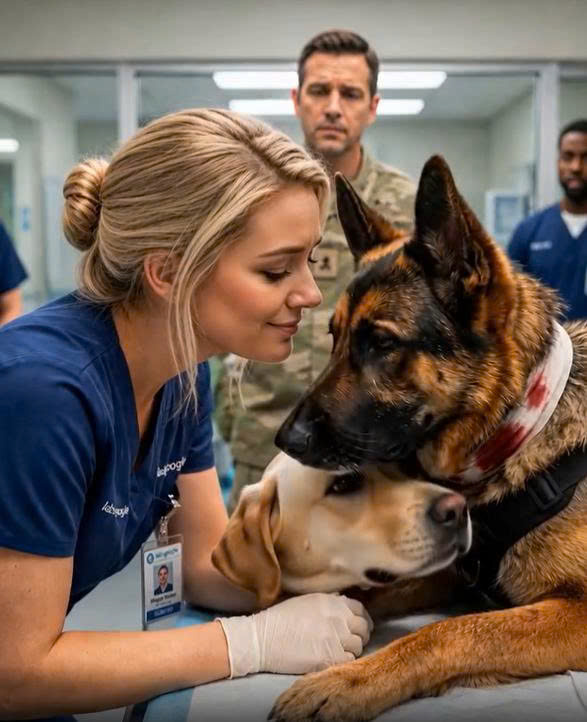
On it lay a German Shepherd.
Massive. Dark sable. Ninety pounds at least, perhaps more when healthy. Mud streaked his coat. Blood soaked through a compression bandage wrapped around his torso, spreading in a dark red fan beneath him. His breathing came fast and shallow. One ear was torn. His left shoulder bore old scar tissue, pale against wet fur.
His eyes were open.
They moved over every person in the room.
Not wild.
Not confused.
Trained.
Emma felt the old part of herself sit up inside her body.
Caldwell stepped forward. “What the hell is this?”
The man at the head of the stretcher had a square jaw and a scar cutting through his left eyebrow. “Dog needs surgery now.”
“This is a human hospital.”
“Now,” the man repeated.
The word was flat. Final. It had the shape of command, but not enough authority to make it right.
Caldwell’s jaw tightened.
She did not like being ordered around in her own bay.
No one did.
“Get me a veterinary consult on the phone,” she snapped at Torres. “If we’re forced into madness, I at least want madness witnessed.”
The dog was lifted onto the trauma table.
The moment a paramedic reached to adjust the IV line, the Shepherd exploded.
Not randomly.
Not from panic.
He twisted with terrifying precision, head snapping toward the hand that came too close. His teeth flashed white. The paramedic jerked back so violently he knocked a tray of instruments to the floor. Metal scattered across linoleum.
“Hold him down!” Caldwell barked.
Two tactical men moved in.
The dog snarled and slammed his body sideways, the restraints rattling. One man cursed and backed off with his hands raised.
“Doc,” the scarred man warned, “this animal is combat trained. Touch him wrong, he’ll take your hand.”
“Then sedate him.”
“We tried. He’s fighting through it.”
Caldwell grabbed a syringe from the crash cart.
Emma saw the dog’s eyes lock onto it.
His whole body changed.
Caldwell took one step toward the table.
The Shepherd lunged so hard the table shifted.
The IV stand crashed down.
Someone screamed.
Caldwell staggered backward, syringe dropping from her hand.
Emma moved before she thought.
“Platz.”
The word cut through the room.
Quiet.
Calm.
Exact.
The dog stopped.
His body went rigid, trembling beneath the restraints, blood still seeping through the bandage. But he stopped.
Every person in the bay turned.
Caldwell stared at Emma as if the quiet nurse had opened a door in a wall everyone else thought was solid.
“What did you just say?”
Emma kept her eyes on the dog.
“Command.”
“I know it’s a command.” Caldwell’s voice went cold. “How do you know it?”
Emma did not answer.
She stepped closer to the table, slowly, hands open and visible. No direct eye contact. No sudden reach. No fear in her shoulders, though her pulse was hammering beneath the collar of her scrubs.
The Shepherd watched her.
She watched his breathing, his pupils, the direction of his weight. His head turned toward the door, then toward the tactical men, then back to Emma.
He was not trying to attack.
He was trying to protect a battlefield that no longer existed.
“Easy,” she said softly. “You’re not there anymore.”
His ears flicked.
Caldwell snapped, “Hartley, step back.”
“He isn’t aggressive.”
“He just tried to take my arm off.”
“He guarded against a perceived threat.”
“Guarded what?”
Emma finally looked at her.
“His handler.”
The scarred tactical man spoke from the foot of the table.
“Handler’s KIA. Explosion near Pier Seventeen two hours ago.”
The room changed.
Even Caldwell’s anger faltered.
Emma turned back to the dog.
She could see it now in every line of him. The stiff spine. The refusal to yield. The frantic flick of his eyes toward exits. The way he kept trying to angle his body around the empty space to his right.