Snow made the harbor quiet in a way Mark Sullivan no longer trusted.
It softened the hard edges of Mariner’s Bluff, covered the rusted bollards along the docks, blurred the lobster traps stacked behind the bait shop, and turned the narrow streets into pale ribbons between old brick buildings. From a distance, the town looked gentle under winter. Up close, it smelled of diesel, saltwater, wet rope, fried onions from the diner, and the cold metallic breath of the Pacific beating against the pier.
Mark rolled his wheelchair through all of it with a paper bag of groceries balanced across his knees.
The wheels cut twin dark lines through the snow.
Six months ago, he would have walked this route without thinking. He would have passed the harbor mart with Duke at his left side, the German Shepherd’s vest snug around his powerful chest, his amber eyes catching everything Mark missed. Duke would have sniffed the alleys, ignored the gulls, judged drunks with professional disdain, and leaned against Mark’s leg at crosswalks as if reminding him the world moved better when they moved together.
Now Mark moved alone.
At thirty-five, he still wore his police jacket zipped high against the wind and tactical boots he could no longer stand in without braces and parallel bars. He kept his badge clipped at his belt because taking it off felt too close to admitting the shooting had taken more than his legs. His dark hair had begun to gray near the temples. His storm-gray eyes scanned windows, doorways, alleys, and parked cars with the reflexes of a man who had not forgotten the job even if the department had quietly begun forgetting where to place him.
The shooting had happened at the northern warehouse during a raid on the Strayhook ring.
That was what the papers called them: a drug operation using fishing routes to move fentanyl, stolen weapons, and cash through the harbor. Mark still remembered the wet shine of the loading dock, the smell of rotting bait, Duke’s sharp bark, the van door slamming, the muzzle flash, the impact in his spine, the impossible absence of feeling below his waist, and Duke’s last sound cutting through the storm as men dragged him into the van.
A desperate bark.
Then nothing.
Six months of nothing.
No body.
No collar.
No confirmed sighting.
Only rumors, dead ends, and a department that had stopped saying we’ll find him and started saying you need to focus on recovery.
Recovery.
Mark hated the word.
Recovery sounded like something returned to you. But his world had become a narrower map: apartment, clinic, grocery store, rehab center, harbor path if the weather allowed. His legs were quiet. His apartment was quieter. Duke’s collar sat on his desk under a lamp, the brass tag dented and scratched from years of work.
Every night Mark touched it like a prayer he did not believe in.
The wind rose sharply at the corner of Harbor and Third, slicing between the boarded-up diner and the old print shop. Mark turned into the alley for shelter, angling his chair through packed snow and shadow. The alley smelled of frozen garbage, old grease, wet cardboard, and the sea. A rusted fire escape hung overhead. Icicles formed along a drainpipe. Snow lay in soft dunes against the brick walls, covering broken glass and cigarette butts.
He had patrolled this alley with Duke dozens of times.
His wheels squeaked in the cold.
Then he heard it.
A whine.
So faint the wind nearly swallowed it.
Mark stopped.
The grocery bag shifted on his knees. A can rolled against a loaf of bread. He held his breath.
The sound came again, lower this time. Not a bark. Not a stray’s sharp complaint. A torn, exhausted sound dragged up from the bottom of a body that had almost stopped asking.
Mark pushed forward.
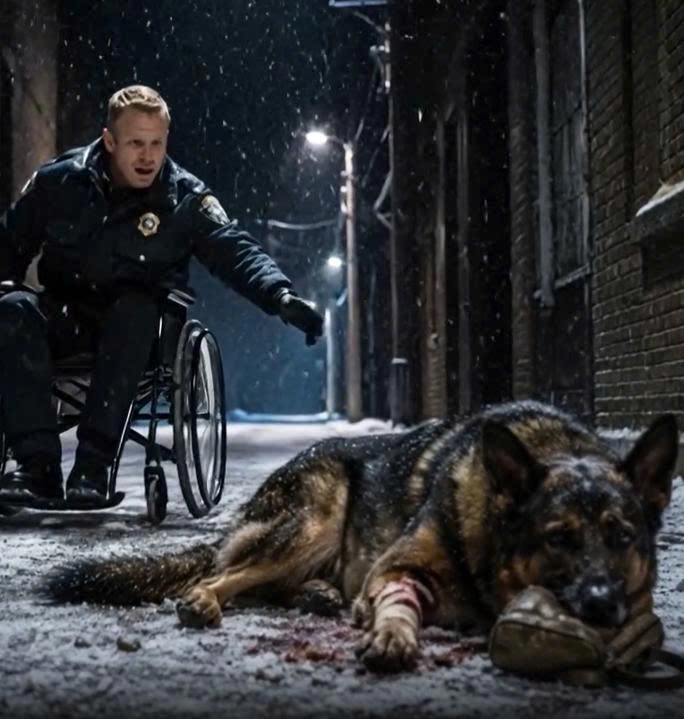
Halfway down the alley, near an overturned trash can, something dark moved against the snow.
A dog.
Large.
German Shepherd.
For one second Mark’s mind refused the shape. It put distance between recognition and hope because hope had become dangerous. The dog lay on his side, sable-and-black coat matted with mud and blood, ribs rising shallowly. One hind leg was twisted under him. Blood streaked the snow behind him in a thin red line. Clenched between his jaws was a torn canvas bag.
The dog lifted his head.
Amber eyes met Mark’s.
The grocery bag slid from Mark’s lap.
A can struck the pavement and rolled away.
“No,” Mark whispered.
The dog’s ears shifted.
The left ear had a small notch from a training accident three years earlier, when Duke had cleared a fence too fast during pursuit work and clipped wire hard enough to bleed. Mark had teased him for weeks afterward, calling it his pirate mark.
The scar along the muzzle was there too.
The white hairs beneath the chin.
The steady, intelligent stare, dimmed now by pain but still unmistakable.
“Duke.”
The name tore out of him.
The dog’s tail moved once in the snow.
Once.
Then he dragged the canvas bag another inch toward Mark, as if duty mattered more than blood.
Mark did not remember moving.
He only knew that suddenly he was on the ground, having shoved himself out of the wheelchair with the practiced violence of a man who had fallen before and did not care about falling now. His knees hit the snow. He crawled forward on gloved hands, pain sparking through his hips and back, useless legs trailing behind him.
“I’ve got you,” he said, voice breaking. “I’ve got you. I’ve got you.”
Duke released the bag.
His tongue flicked weakly over Mark’s glove.
The canvas flap fell open.
Inside, Mark saw a hard drive wrapped in plastic, a flash drive taped to it, and a folded piece of paper smeared with blood along one edge.
Duke had carried evidence.
He had crawled through snow, bleeding, starving, broken, and still brought the bag home.
Mark pressed one hand to Duke’s neck. The pulse was there, thready but real. He tore off his jacket and wrapped it around the dog’s body. Duke shuddered beneath it.
“You stupid, perfect dog,” Mark whispered. “You came back.”
He fumbled for his phone with numb fingers and called the only person he trusted with a dying animal in a storm.
“Harbor Paws,” came Emily Carter’s voice.
“Emily.” His breath hitched. “It’s Duke. I found Duke. He’s alive. He’s hurt bad.”
A beat of silence.
Then her voice sharpened.
“Where?”
“Alley behind the old print shop.”
“I’m coming. Don’t move him unless you have to. Keep him warm. Talk to him.”
Mark almost laughed because he had not stopped talking.
He ended the call and lowered his forehead to Duke’s.
“Stay with me.”
Duke’s eyes fluttered.
“No,” Mark said sharply. “You don’t get to quit after crawling back here. You hear me? You don’t get to leave me twice.”
Duke’s breath rattled.
Snow fell harder, covering Mark’s shoulders, his hair, the scattered groceries, the blood trail, the dark wheels of his chair. At the mouth of the alley, headlights turned in fast. A small truck braked hard, tires sliding. Emily Carter jumped out before the engine settled, a red medical bag already in her hand.