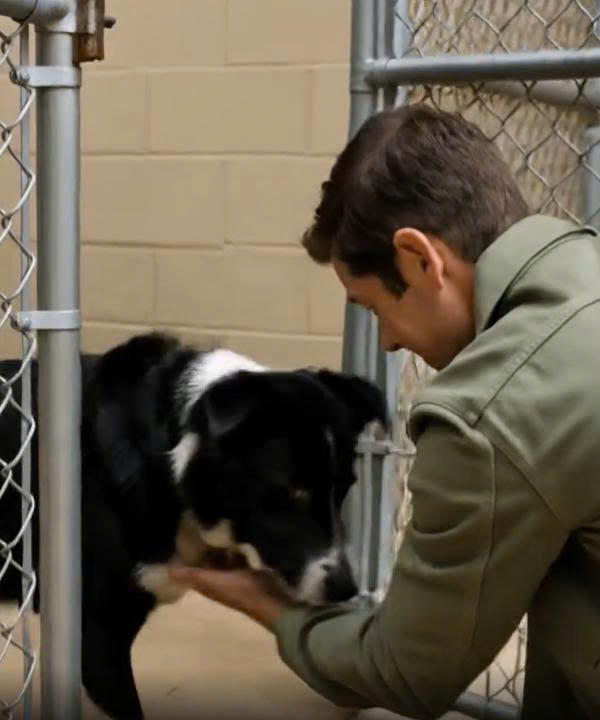
I did not go to the shelter to adopt a dog.
I went there to say goodbye.
The words came out of me before I knew I meant to speak them, and the young woman behind the front desk looked up from her clipboard with a startled kindness that made me wish I had kept quiet.
“I’m sorry?” she said.
I cleared my throat. “Nothing. I mean… I’m just looking.”
That was not true either.
A man can lie to a stranger more easily than he can lie to himself, but that morning even the small lies had begun to feel heavy.
The Haven County Animal Shelter sat at the edge of a two-lane road bordered by thinning pines and winter-bare fields. It was a low grey building with a blue sign and a row of muddy paw prints painted near the entrance. Mist hung around the place, softening the windows, making everything beyond them look a little unreal. I had driven through two towns to get there in a car that still smelled faintly of my late wife’s lavender sachets. One had slipped beneath the passenger seat years ago, and I had never looked for it properly. Some things are easier to leave where they fall.
My name is Thomas Sanders.
I was sixty-two then, retired from electrical work, widowed for almost three years, and living in a modest house off Maple Drive that had grown too quiet around me. Quiet in the walls. Quiet in the cupboards. Quiet in the evenings when the television spoke to no one and the kettle boiled for one cup instead of two.
My daughter Amanda rang every Sunday. My granddaughter Ellie sent drawings in the post. Neighbours waved when I took the bins out. Everyone was kind enough. That was the trouble with loneliness: it did not always arrive because people were cruel. Sometimes it came because life politely continued elsewhere.
“You looking for anything in particular?” the volunteer asked.
She was maybe twenty-five, with a neat ponytail, tired eyes, and the careful cheerfulness of someone who had learned that hope was part of the job.
“No,” I said. “Not really.”
“You’re welcome to walk through the kennels. I can answer questions after.”
I nodded and followed the sound of barking through a swinging door.
The kennel corridor was clean, bright, and loud. Dogs of every size and shape pressed towards the chain-link fronts: a yellow lab bouncing on his back paws, two beagles howling as if rehearsing for opera, a terrier spinning in circles, a shepherd mix watching me with solemn suspicion. Each kennel had a card clipped to it. Names. Ages. Notes in black marker.
Friendly. Energetic. Loves walks.
Good with children.
Needs quiet home.
No cats.
Knows sit.
I had owned dogs before. Rosie, our golden retriever, had died the year after my wife. She had been old, sweet, ridiculous, and convinced that every biscuit in the house belonged to her by moral right. After she passed, I told Amanda I was done with dogs. Done with hair on the carpet, muddy paws, vet bills, the heartbreak of loving something with a shorter life than yours.
In truth, I was afraid.
I had already lost too much.
Halfway down the corridor, the barking became background. I walked past hope after hope, each dog offering itself to me in whatever way it knew. Tails wagging. Paws lifted. Ears pressed back. Mouths open in nervous smiles.
Then I reached the last kennel on the left.
She was not offering anything.
She was a skinny black dog with ragged ears and deep brown eyes, curled in the far corner as if she had been placed there and forgotten to unfold. Her fur was dull and patchy. A white scar cut through the hair over one shoulder. Her ribs showed faintly under the skin. She did not bark when I stopped. Did not rise. Did not wag.
She looked at a spot on the concrete floor.
As if the world had already asked too much of her, and she had decided not to answer again.
I stood there longer than I meant to.
The volunteer came up behind me, softer now.
“That’s Clara.”
The dog’s eyes flicked once towards the name.
Barely.
“What’s her story?”
“Found behind a gas station off Route 10 about six weeks ago,” the volunteer said. “No tags. No chip. She was in rough shape. Starved, dehydrated, infected wounds. It took us a while to get her stable.”
“Anyone interested?”
The volunteer hesitated.
That told me before she answered.
“Not really. She doesn’t show well. People want dogs that come to the front.”
I looked at Clara.
“What happens if no one takes her?”
“We do our best,” the young woman said.
People always say that when the truth is too sharp to hand over.
I crouched slowly, knees cracking. Clara did not move away. She did not move closer either. Her eyes rose to meet mine for less than a second, then dropped again.
I had seen that look before.
Not in dogs.
In mirrors.
“I didn’t come here to adopt,” I said.
The volunteer was quiet.
“I know,” she said gently.
The paperwork took less time than I expected for such an unreasonable decision.
When the volunteer clipped a leash to Clara’s collar, the dog stood because she was asked, not because she believed anything good would happen. Her legs trembled as we walked to the car. I opened the back door and spread an old fleece blanket across the seat. It was the blanket Rosie had once used after lake walks, folded in the boot since the previous winter.
Clara sniffed it.
Then climbed in slowly and curled into a tight, dark comma.
The drive home was silent.
I kept glancing in the mirror, half expecting her to disappear, but she remained curled there, eyes open, watching nothing.
At the house, she stopped on the porch.
“Come on,” I said softly.
She stared at the open doorway as if it were a mouth.
I stepped inside first, then moved back, giving her space.
After a long moment, Clara crossed the threshold.
Her nose twitched. She sniffed the hall rug, the edge of the umbrella stand, the skirting board near the sitting room, Rosie’s old water stain by the kitchen door that no amount of cleaning had fully erased. Her tail stayed low, but she did not bolt.
“You can stay as long as you like,” I said.
Clara did not answer.
But she did not leave.
That night, I made a bed for her in the kitchen with towels and the fleece blanket. She looked at it, then looked at me, then lay in the hallway outside my bedroom door. Not inside. Not far away. Near enough to listen. Far enough to escape.
At midnight, I heard her shift.
Nails clicked softly on the wooden floor.
I opened my eyes in the dark.
For one moment, I forgot she was there, and the old loneliness had already begun to settle over me like dust.
Then I heard her breathing.
Not mine.
Hers.
Soft. Uneven. Alive.
I lay still and listened until morning.
## Chapter Two
### The House with Two Silences
The first week, Clara lived like a guest who expected to be asked to leave.
She ate carefully. Not greedily, though she must have known hunger well. She took each bite as if checking whether it was allowed. If I moved while she was at the bowl, she would pause, eyes lifting to my hands. The first time, I backed all the way into the sitting room and pretended to study the bookshelf until she finished.
Trust, I discovered, could look like a dog eating while you stood nearby.
She followed me from room to room, but never too closely. If I went into the kitchen, she sat in the hall. If I sat in the armchair, she lay by the door. If I went outside to water the hydrangeas, she stood at the back step and watched the hose as though it might turn on her.
I talked to her because silence had become uncomfortable in a different way.
“Those are Mae’s hydrangeas,” I told her one damp afternoon. “She planted them the year Amanda got married. Said they made the house look like it had manners.”
Clara blinked from the step.
“My wife,” I added, though I did not know why. “Mae.”
The name felt strange in the open air.
After Mae died, I had stopped saying her name unless necessary. I spoke around it, the way one walks around loose floorboards at night. Your mother. My wife. She. Her. As if the name itself might summon a room I was not strong enough to enter.
Clara listened without flinching.
That was her gift from the beginning.
Not affection. Not yet. Listening.
On the fifth day, she barked.
I was standing on the porch with coffee when a squirrel ran along the fence. Clara, sitting in the doorway, lifted her head and let out one sharp, startled bark. The sound made me spill coffee down my sleeve. It seemed to surprise her too. Her ears rose. Her eyes widened. She looked at me as if I had done it.
“Well,” I said. “So you do have opinions.”
Her tail moved once.
Barely.
The next day, I bought a rubber ball.
It was blue and ugly and squeaked when I tested it in the shop, which made me laugh, then embarrassed me because I was standing alone in a pet aisle laughing at a ball. I bought it anyway.
At home, I rolled it across the sitting room.
Clara watched it.
The ball bumped against the leg of the coffee table and stopped.
She looked at me.
I looked at her.
She walked away.
“Fair enough,” I said.
I tried again the next day.
And the next.
On the tenth day, she followed it.
She did not pick it up. She trotted after it, touched it with her nose, then looked back at me.
You would have thought she had performed surgery.
“Good girl,” I said, and my voice cracked on the second word.
That evening, I sat on the floor beside her bed. My joints complained, but I ignored them. Clara lay curled on the blanket, eyes half-closed. Slowly, very slowly, I reached out and touched her side.
She flinched.
Then stayed.
I kept my hand there, light as a fallen leaf.
“You don’t have to be scared anymore,” I whispered.
Her eyes closed.
I did not know whether she believed me.
I did not know whether I believed myself.
Three weeks passed.
Then a month.
Clara began to fill out. The hollows along her ribs softened. Her fur grew darker and shinier, though the scars remained. She started sleeping on the rug by the sofa instead of the hall. Then, one evening, as I watched some detective programme I could not follow, she climbed onto the cushion beside me.