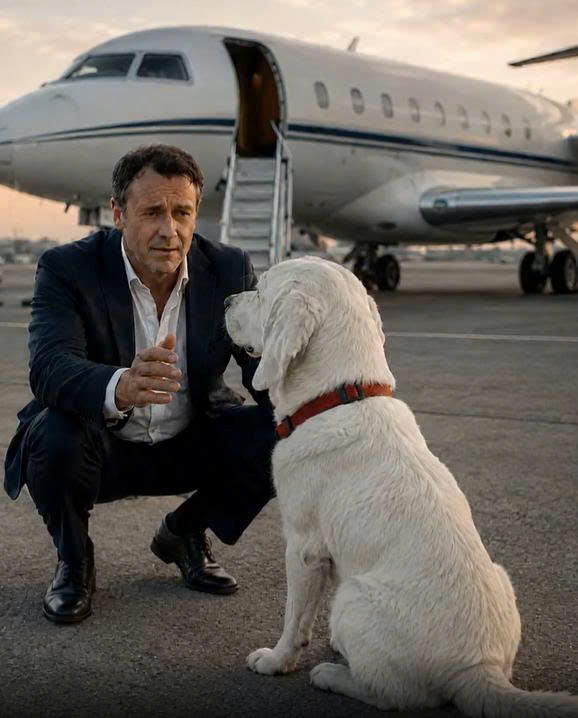
Marco Rivera had not touched American soil in four years, and when he finally did, an old dog was sitting in the middle of the runway path as if he had been keeping the whole country from moving on without him.
The plane had just come to a stop at the small regional airport outside Cedar Falls, Oregon, where passengers still descended by metal stairs instead of a jet bridge. Heat shimmered over the summer tarmac. The sky was the color of dull pewter in the west, but low gold sunlight broke beneath the clouds and turned every wing, window, and fuel truck into something bright enough to hurt.
Marco stood at the top of the stairs with his backpack hanging from one shoulder and his right hand clenched around the railing.
For a moment, he could not move.
Four years.
Four years of foreign hotels, temporary apartments, factory sites, airports that smelled like fuel and coffee, cities where nobody knew his name unless it was printed on a badge. Four years of working in Singapore, Doha, Manila, Seoul, and once, for seven miserable months, in a mining town in western Australia where the wind tasted like red dust and loneliness.
Four years of telling himself distance was survival.
Four years of not coming home.
Behind him, a woman cleared her throat.
“Sir?”
Marco stepped down one stair.
Then another.
On the third step, he saw the dog.
The old animal sat at the base of the marked passenger path, just beyond the yellow safety line where the ground crew guided people toward the terminal. He was a German Shepherd mix, black and tan once, though age had silvered his muzzle almost white and softened the dark mask around his eyes. His ears stood unevenly—one sharp, one folded at the tip. Around his neck was a red collar faded nearly pink by sun and weather.
Marco’s foot hovered over the next stair.
His lungs stopped working.
No.
Impossible.
The dog did not bark.
He did not jump or whine or run.
He simply looked at Marco.
Straight at him.
With the same amber-brown eyes that had watched him tie his boots every morning for twelve years. The same eyes that had waited beside the front door on rainy nights. The same eyes that had once stared at him from the hallway while Marco and his wife, Elena, stood in the kitchen saying things they could never unsay.
“Charlie,” Marco whispered.
The name barely left his mouth.
The passenger behind him bumped his shoulder.
“Hey, man, you okay?”
Marco gripped the railing tighter.
The ground seemed too far away.
Charlie tilted his head.
Just slightly.
Just the way he used to when Marco came home late and said, “Don’t judge me, old man,” and the dog, with absolute moral clarity, judged him anyway.
The gesture broke something in Marco.
He came down the steps as if moving through warm water. The engine hum faded. The heat, the people, the voices, the orange vests of ground crew, all of it seemed to dissolve around the shape of that dog.
A young ramp worker in a reflective vest took two quick steps toward him.
“Sir, please stay on the marked path.”
Marco did not hear him.
Or he heard him and had already left obedience behind.
Charlie remained still.
Only his tail moved.
Once.
Not a wag of joy.
A signal.
I see you.
I waited.
Marco dropped to one knee on the hot tarmac.
His hand reached toward the dog and stopped inches from the gray muzzle. He was suddenly terrified that if he touched him, Charlie would vanish. A mirage. A fever dream from thirty-two hours of travel and too many layovers. A cruel trick his guilt had waited four years to play.
Charlie leaned forward and pressed his forehead into Marco’s palm.
Warm.
Real.
Alive.
Marco made a sound he had not made since the night he left Cedar Falls.
It was not a sob exactly. It was lower than that, dragged up from somewhere beneath pride, anger, and all the hard language he had used to survive absence.
He folded over the dog.
His arms went around Charlie’s neck. His face sank into fur that smelled like sun, dust, grass, old rain, and home. He felt the narrow shoulders beneath his hands. The bones that had become sharper. The softness around the ears. The familiar weight of a living thing that had never learned how not to love him.
“I’m sorry,” Marco whispered. “I’m sorry. I’m so sorry.”
Charlie stood there and let him fall apart.
The ramp worker stopped a few feet away.
He was young, maybe twenty-two, with a radio clipped to his vest and an expression that shifted from alarm to confusion to something gentler.
“Sir,” he said softly, “do you know this dog?”
Marco laughed once through tears.
“Know him?”
He pulled back and cupped Charlie’s face in both hands.
“This is my dog.”
The ramp worker’s eyes widened.
“The airport dog?”
Marco looked up.
“What?”
The young man glanced toward the terminal, then back at Charlie.
“He comes here every day. Or he used to. With a woman. They sat by the observation fence.”
Marco’s hand tightened in Charlie’s fur.
A woman.
Elena.
“What woman?”
The worker’s discomfort was immediate.
“I don’t know her name, sir. She’s been coming for years. She tells security she’s waiting for someone. Everyone kind of knows them.” He looked at Charlie. “But the last few days, he’s been coming alone. Today he slipped past the service gate when your plane landed.”
Marco stared at him.
Charlie nudged Marco’s wrist.
That was when Marco saw the paper.
It was tucked under the red collar, folded so tightly that only a corner showed against the dog’s neck. Yellowed at the edges. Soft from handling. Protected in a strip of clear plastic that had cracked near one fold.
Marco’s fingers trembled as he eased it free.
He unfolded it carefully.
The handwriting struck him before the words did.
Elena’s.
Small.
Slanted.
Uneven now in a way it had not been before.
For one second, Marco could not read. Tears blurred the page until the blue ink became water. He wiped his face with the back of his hand and forced himself to focus.
**Marco,**
**If you are reading this, it means you came home.**
The tarmac vanished.
The world narrowed to paper, dog, and the sound of his own heart.
**I knew you would, even when I told people I didn’t. Charlie knew too. Every day for four years, I brought him to the airport. We sat on the bench by the observation fence, the one where you can see the landing path. I told him stories about you. I told him, “Daddy’s coming home.” At first I said it for him. Then I said it for myself.**
Marco pressed one hand over his mouth.
Charlie leaned against his knee.
**I got sick, Marco. Sicker than I wanted to admit. I am writing this from St. Jude’s Hospital because I cannot come to the airport anymore. But Charlie will. He always knew how to wait better than either of us.**
**If you can forgive me, come. If you cannot, come anyway. There are things you deserve to know. There are things I should have told you before you left.**
**I am still here.**
At the bottom, in shaking letters, was a room number.
**St. Jude’s Hospital. Room 417.**
The date was three days earlier.
Marco lifted his head so quickly the ramp worker stepped back.
“St. Jude’s,” he said. “How far?”
The worker blinked.
“Twenty minutes, maybe. Less if traffic’s good.”
Marco stood, gripping the letter.
Charlie stood too, slower, stiff in the hips but alert.
The old dog looked toward the terminal with something close to impatience.
As if he had done his part.
As if humans were the slow ones now.
Marco turned toward the airport building.
His backpack slid down his shoulder. He did not fix it.
He looked at Charlie and said the words he had not said in four years.
“Come on, old man. Let’s go home.”
Charlie’s tail moved once.
Just once.
Exactly like before.
Then he walked ahead, looking back every few steps to make sure Marco followed.
## Chapter Two
### The Man Who Left
Four years earlier, Marco Rivera left Cedar Falls without saying goodbye to the dog.
That was the detail that haunted him most.
Not the argument with Elena.
Not the slammed kitchen drawer.
Not the suitcase he packed badly because rage makes a man careless and grief makes him worse.
The dog.
Charlie had stood in the hallway while Marco shoved clothes into a duffel bag. He was younger then, still broad across the shoulders, his muzzle only beginning to gray. He watched with his ears half lowered, understanding movement if not reasons. Dogs always know when departure is different.