For three weeks, I saw the dog every morning on my way to work, and every morning he was guarding the same red suitcase like the whole world had been warned not to touch it.
The first time, I barely slowed down.
That is the truth, and I am not proud of it.
It was late August in Phoenix, the kind of morning when the heat was already climbing before the sun had fully cleared the roofs, when the asphalt looked tired and every car interior smelled faintly of dust, coffee, and old plastic. I drove Jefferson Road every weekday because it cut twelve minutes off my commute to the warehouse. Twelve minutes mattered when your job started at seven, your back hurt before six, and your life had become a collection of routines built to keep you from thinking too much.
The dog sat beside a bus stop that no bus had serviced in years.
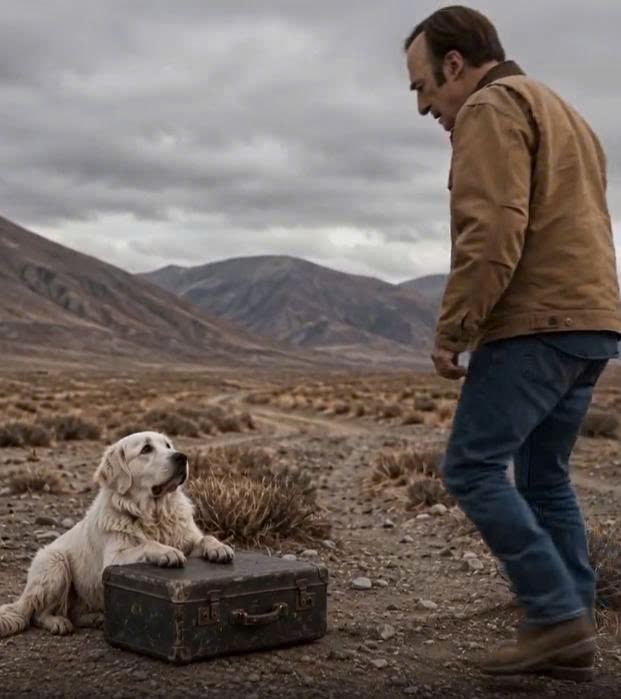
Golden retriever, or close enough. Too thin. Fur dull with road dirt. One ear slightly torn. He sat with his body curved around a small red suitcase, the old hard-sided kind with metal latches and a cracked leather handle. His head was up. His eyes followed passing cars, not greedily, not hopefully exactly, but with a focus that made him look less like a stray and more like someone waiting for instructions.
I saw him, thought, poor thing, then kept driving.
That is how easily suffering becomes scenery when you are practiced at not stopping.
The second day, he was there again.
Same place.
Same suitcase.
Same position, front paws touching the red plastic, chest nearly covering it, as if whatever lay inside was more important than food, water, shade, or his own life.
I told myself someone nearby was feeding him.
The convenience store on the corner, maybe. The old tire shop. A homeless camp under the canal bridge. Dogs belonged to people. Suitcases belonged to people. Stories belonged to people who had time to follow them.
I did not.
My name is Henry Miller. I was fifty-nine years old then, though I felt older in the mornings and younger only when I forgot to pass a mirror. I worked inventory control at a distribution warehouse outside Tempe, a concrete box full of forklifts, bar codes, fluorescent lights, and men who said they were fine because nobody wanted the longer answer. I had been there eleven years. Long enough to know where every broken pallet jack was hidden and which supervisor smiled before firing someone.
I had been married twice.
Both marriages ended quietly, which is not the same as ending kindly.
My first wife, Laura, left after our son, Josh, turned fourteen. She said I was never home even when I was sitting at the kitchen table. She was right. My second wife, Ellen, lasted six years and left after saying she was tired of living with a man who treated love like a lease agreement.
I had a son who did not call.
I had an apartment that smelled of microwave dinners and old air-conditioning.
I had a coffee mug that said **World’s Okayest Dad**, given to me by Josh when he was twelve and still thought disappointment could be turned into a joke.
I did not have room for a dog.
That was what I told myself.
On the fourth day, I saw two teenagers walking toward him.
They wore school backpacks and the swagger of boys who had not yet learned that cruelty leaves fingerprints inside the person who performs it. One pointed at the suitcase. The other laughed. The dog stood.
Not barked.
Stood.
His body became a wall.
The boys stopped. One reached out a foot toward the suitcase, pretending to kick it.
The dog lowered his head.
Still no bark.
The boys backed away, cursing and laughing too loudly.
I watched all of this through my windshield while waiting at the red light.
When the light changed, I drove on.
At work, I thought about the dog all morning.
That annoyed me.
I miscounted a pallet of bathroom fixtures twice. My supervisor, Marcy, looked over her glasses and said, “You sleep last night?”
“Enough.”
“That’s not an answer.”
“It’s the answer I have.”
She studied me for a moment. Marcy was forty-eight, sharp as a box cutter, and kind in ways she disguised as irritation. “Well, get a better one before you forklift your own foot.”
At lunch, I sat outside by the loading dock and searched local lost-dog pages on my phone.
Golden retriever. Red suitcase. Jefferson Road.
Nothing.
On the seventh day, I brought a bottle of water.
I didn’t plan to stop. I simply put the bottle in my passenger seat. That was the lie I told myself. It was there in case. In case what, I could not have said. In case the dog looked worse. In case no one else stopped. In case I became a better person at the exact moment I reached that old bus stop.
He was there.
The suitcase was there.
The heat had already begun to shimmer off the sidewalk.
I pulled into the cracked parking lot beside the closed laundromat and sat with the engine running.
The dog watched my car.
His eyes were amber-brown and empty in a way that felt too familiar.
Like his body was present, but some essential part of him had been taken down the road and had not returned.
I knew that look.
I saw it every morning when I shaved.
I got out with the water.
The dog stood over the suitcase.
“Hey,” I said.
My voice sounded stupid in the hot air.
His ears lifted.
“I’m not touching it.”
He did not believe me.
I unscrewed the cap from the bottle slowly and poured water into the empty plastic tray of a broken newspaper box near the bench. The water splashed loud against sun-warped plastic.
The dog’s nose twitched.
He looked at the water.
Then at me.
Then back at the suitcase.
“I’ll step back,” I said.
I did.
He waited another thirty seconds before moving. Even then, he did not fully leave the suitcase. He stretched his neck toward the tray and drank with his back legs still braced beside it. Long, desperate pulls of water. His throat worked hard. He drank like water was something that might disappear if he trusted it too long.
When he finished, he returned to the suitcase and sat.
I left.
The next day, I brought water and tuna.
I had three cans in my pantry because I bought them during a sale and then remembered I didn’t particularly like tuna. The dog did. He ate fast, barely chewing, eyes flicking up between mouthfuls as if expecting the food to be taken away.
“You’re going to make yourself sick,” I told him.
He ignored me.
On the tenth day, the woman from the tire shop came out while I was crouched near him.
“Been feeding him?” she asked.
She was in her sixties, small, with gray hair wrapped in a scarf and a cigarette she did not light.
“Trying.”
“He won’t leave that suitcase.”
“I noticed.”
“Animal control tried last week.”
“What happened?”
She nodded toward the dog. “He let them come near him. Then one guy reached for the case.”
The dog, hearing the word or the memory in her voice, lowered his head over the suitcase.
The woman’s mouth tightened. “He didn’t bite. But he made it clear he could.”
“How long has he been here?”
“Three weeks, maybe. Before that, I don’t know.”
“Someone dump him?”
She looked at the suitcase.
“Maybe. Maybe someone meant to come back and didn’t.”
That sentence stayed with me.
Someone meant to come back and didn’t.
I had been that someone in smaller ways.
Not with a dog at a bus stop. With calls unanswered. Birthdays missed. A son learning not to expect me in the bleachers. You do not have to abandon someone on a roadside to teach them how to stop waiting.
On the fifteenth day, I brought a leash.
I kept it in my pocket.
The dog ate tuna, drank water, then sat with one paw on the suitcase.
“What’s in there?” I asked.
His ears moved.
“Gold? Stolen diamonds? Government documents?”
Nothing.
“A bomb?”
He blinked.
“Probably not. You don’t seem like the bomb type.”
A car honked as it passed. The dog flinched, then leaned closer to the suitcase.
I sat on the curb ten feet away until my shirt stuck to my back.
“My son doesn’t call,” I told him.
The dog looked at me.
“I don’t blame him. Mostly.”
He settled his chin on the red suitcase.
“I guess I do blame him sometimes, which is ugly. Easier to be angry than honest. He has reasons. I taught him not to need me. He learned.”
The dog kept watching.
Animals are dangerous that way. They don’t interrupt your excuses.
On the eighteenth day, he let me touch his shoulder.
Only briefly.
His fur was rough with dust, warm from the sun. He stiffened under my hand, then relaxed by half an inch. That was all.
It felt like being trusted with a match in a dry field.
On the twenty-first day, the monsoon clouds gathered.
By ten in the morning, the sky had turned bruised purple over the city. Heat pressed down, wet and electric. I stopped at the bus stop on my way to work because I knew if the storm broke, the dog would be soaked.
He was standing now.
Not over the suitcase.
Beside it, looking down Jefferson Road, body trembling.
“Hey, buddy.”
He looked at me.
Thunder muttered far off.
The dog’s body folded inward.
He grabbed the suitcase handle in his mouth and tried to drag it under the bus bench. It scraped against the concrete, awkward and heavy. His teeth slipped. He tried again.
The storm cracked open.
Rain hit the street in fat, hard drops.
The dog panicked.
Not at the rain.
At the thunder.
He dropped the suitcase and crouched over it, shaking so violently his legs nearly gave out.
Something inside me made a decision before I finished arguing with it.
I opened my truck door.
“Come on.”
He stared at me.
“Bring it.”
I stepped toward the suitcase.
He growled.
Low.
Terrified.
I stopped.
“I know. I know. I’m not taking it from you.”
I crouched and held out the leash, not clipping it, just letting him see it.
Thunder cracked again, closer.
The dog whimpered.
I picked up the suitcase with one hand.
The growl turned into a cry.
“I’m bringing it,” I said. “Look. It comes too.”
I placed the suitcase on the truck floor, passenger side.
The dog stared.
Rain ran down my face, into my collar. Cars hissed past in sheets of dirty water.
“Come on,” I said again.
For three seconds, he did nothing.
Then he jumped into my truck.
He landed awkwardly, immediately placing his body over the suitcase. His wet fur smelled like dust, rain, fear, and old sadness. He pressed his muzzle against the red case and shook.
I closed the door.
Then I stood in the rain beside my truck, one hand on the handle, and realized my life had just become something I had not planned.
At work, I called in sick.
Marcy answered.
“You sound terrible,” she said.
“I’m not coming in.”
“That’s what sick means.”
“I found a dog.”
A pause.
“The suitcase dog?”
“You knew?”
“Henry, half the warehouse knows you’ve been feeding a dog like a sad divorced Saint Francis.”
“I hate this workplace.”
“No, you don’t. Take the day.”
I drove home with the dog sitting rigid in the passenger seat, the suitcase beneath his paws. Every few minutes, I glanced at him in the rearview mirror. His golden fur shone under the dashboard light, but his eyes remained hollow.