By the time I touched the dog’s fur, I had already stopped believing we would find anyone alive.
That is not something rescuers are supposed to admit.
We are trained to move carefully, to listen longer than hope reasonably deserves, to treat silence as information rather than finality. We are trained to crawl into places no sane person would enter and speak gently into the dark, even when the dark has not answered for hours. We are trained to keep our faces steady because the people standing behind the tape read our eyes before they hear our words.
But after twelve hours in the ruins of the Bellweather Arms, after two live rescues and nine recoveries, after dust had turned every man on my team the same gray color as the concrete, hope had become something I carried out of habit rather than conviction.
The building had collapsed a little after two in the morning.
Five stories, brick and concrete, built in the seventies in one of Millbrook’s older neighborhoods, the kind of place with cracked sidewalks, iron fire escapes, and tenants who knew better than to complain too loudly because cheap rent always came with hidden costs. A gas leak had been reported two days earlier. A support column in the basement had been flagged six months before that. Later, the papers would use words like “structural failure” and “deferred maintenance,” phrases clean enough to fit in headlines without blood on them.
At the scene, there were no clean phrases.
There was only dust.
Dust in your teeth, your hair, your lungs. Dust coating the teddy bear someone found near the stairwell. Dust on a woman’s purse still zipped shut beneath a slab of concrete. Dust in the eyelashes of men who were too tired to blink.
My name is Ethan Cole. At thirty-eight, I had been with Millbrook Urban Search and Rescue for eight years, long enough to know that every disaster has its own sound. Fires roar. Floods rage. Tornadoes leave a silence that feels stunned.
Collapsed buildings whisper.
They settle. They shift. They breathe. Every creak matters. Every tiny slide of gravel might be harmless or might mean thirty tons of history and bad construction are about to become gravity again.
My team was working the southwest wing, where thermal imaging had shown intermittent heat signatures beneath a pancaked section of the second floor. We had already pulled a teenager out through a narrow void near what used to be the laundry room. We had found an older man alive under a bathtub that had dropped four stories and somehow formed a pocket big enough for his chest to rise.
After that, the heat signatures weakened.
Then disappeared.
“Take five,” Captain Reid said around hour seven.
Nobody moved.
Captain Mara Reid was five foot six, compact, sharp-eyed, and the only person I knew who could make a room full of exhausted rescue techs feel personally judged by their own pulse rates. Her helmet lamp had a crack across one side. Dust streaked her face.
“I said take five,” she repeated.
Jacob Alvarez leaned against a shoring beam and pulled his mask down just enough to drink water. “If we stop, I might not start again.”
“You’ll start because I’ll kick you.”
“Motivational leadership.”
“Proven model.”
I crouched in the crawl space, shoulders pressed between a fractured concrete slab and a beam that groaned every time the building remembered it wanted to fall. My back ached. My gloves were torn at the fingers. My left knee had gone numb an hour earlier.
I should have backed out.
Instead, I turned off my drill and listened.
That is the thing about collapse work. Sometimes the machines lie. Sometimes the sensors miss. Sometimes all you have left is the oldest tool in the human body: listening for another living thing that wants to remain alive.
At first, there was nothing.
Then something moved against my glove.
Not rock.
Not wire.
Warmth.
Soft.
Alive.
My hand jerked back before training caught up.
“Hold,” I said.
Everyone froze.
Captain Reid’s voice came through my headset. “Cole?”
“I’ve got something.”
“What kind of something?”
I lowered my head, angled my flashlight into the pocket ahead, and saw a shape beneath the slab.
A dog.
At first, that was all my mind could make of him.
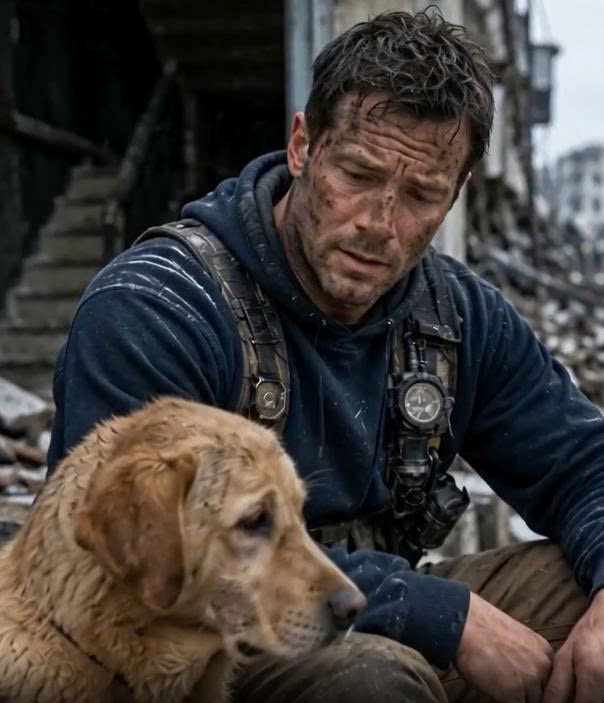
Medium-sized, maybe fifty pounds under the dust, some kind of shepherd mix with a narrow face, black ears, and a coat so coated in cement powder that he looked carved from the wreckage itself. He lay stretched along the edge of a small protected void, body curved like a shield.
Then the dog opened his eyes.
They were not pleading eyes.
That hit me before anything else.
Most trapped animals look panicked or vacant or desperate. This dog looked at me with focus so steady it felt like an accusation.
Not help me.
Not please.
More like: **Finally. Now be careful.**
I shifted the flashlight past him and saw what he had been guarding.
A little girl.
She was tucked beneath a broken dining table wedged between two beams. Six years old, maybe. Dust in her dark hair. Pink pajama shirt. One sock missing. Her cheek rested against the dog’s ribs. She was asleep or unconscious, one small hand tangled in his fur.
My heart slammed so hard I felt it in my throat.
“Live victim,” I said. “Child. Female, approximately six. Dog with her. They’re in a void beneath a table. Southwest pocket, level two collapse.”
The channel lit up instantly.
Reid: “Status?”
“Child appears breathing. Dog conscious. Void is tight. Slab above is unstable.”
Jacob: “I’m bringing the saw.”
“Negative on saw until we brace the upper beam,” I said. “This table is holding a pocket. We cut wrong, we lose it.”
The dog’s eyes stayed on me.
“I know,” I whispered to him. “I see her.”
He blinked slowly.
That was the first time I believed he understood.
Michael Tran, our medic, crawled in behind me with the emergency bag. Jacob and Reid began coordinating shoring outside the void. Every movement became slow, exact, deliberate. We slid braces in by inches. We inflated lifting bags under one slab just enough to relieve pressure but not enough to shift the table. We cleared debris with gloved hands instead of tools where we could.
The dog watched everything.
Every time I reached too close to the girl, he gave a low rumble.
Not a threat.
A warning.
“Easy,” I told him. “I’m not going to hurt her.”
His body trembled with exhaustion, but he did not move away from the child. His front leg was bleeding. His nose had a deep scrape. There was dust packed around his eyes. Still, he kept himself between the rescuers and the girl as if the entire ruined building had entrusted him with one job and he intended to complete it.
“What’s her name?” Michael asked.
“Don’t know yet.”
I leaned closer, keeping my voice low.
“Hey, sweetheart. Can you hear me?”
No response.
The dog licked her temple once.
The girl stirred.
Her eyelids fluttered.
“Mommy?” she whispered.
My throat tightened.
“My name is Ethan,” I said. “I’m with rescue. We’re going to get you out.”
Her eyes opened just enough to find my helmet light.
Then the dog.
She pressed closer to him.
“He saved me,” she whispered.
“What’s his name?”
She blinked slowly.
“I don’t know.”
That undid me more than I expected.
No name.
No collar.
No owner waiting behind the barricades.
A dog nobody knew had held a child alive for twelve hours beneath a collapsed building.
The next eight hours became the hardest rescue of my career.
Not the most dangerous. Not technically. There had been worse voids, deeper fires, flooded basements where the dark moved around your knees. But this one carried a strange unbearable intimacy. Every scrape of debris revealed a little more of the table. Every shoring decision mattered. Every time the girl began to cry, the dog nudged her hand until she touched him and calmed.