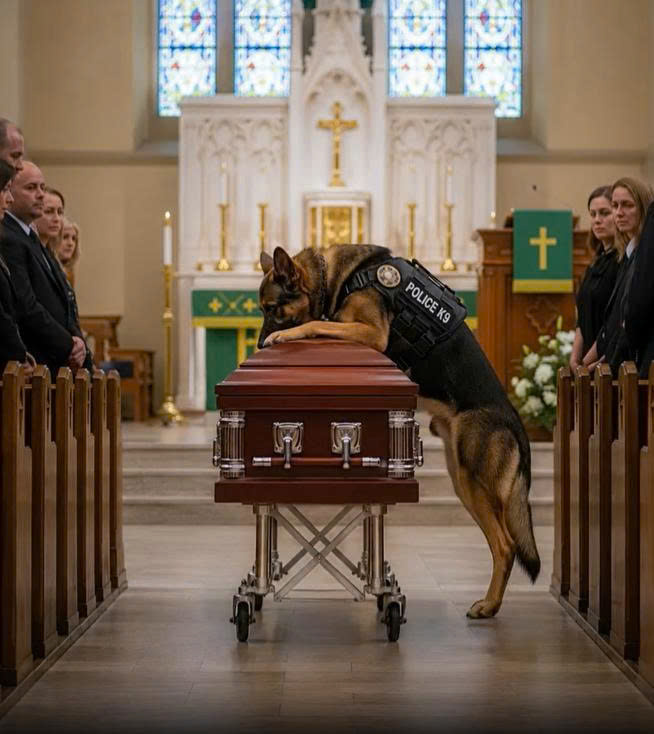
Walter Brooks died on a Tuesday morning before the frost had lifted from the garden.
He had been trying to carry a crate of winter squash to the truck.
That was what broke Helen most afterward—not the ambulance, not the hospital room, not even the doctor’s voice when he said he was sorry. It was the squash. Six of them, pale orange and green-striped, scattered across the gravel drive like small, useless moons. One had split open when it hit a stone, exposing bright flesh to the cold. Another had rolled beneath the bumper of Walter’s old Ford pickup, where it stayed until Lindsay found it two days later and carried it into the kitchen with both hands.
Walter would have hated the waste.
He had grown those squash for the Cedar Grace Church food pantry, as he had grown kale, potatoes, carrots, onions, and winter beans for anyone in town who needed help and did not want the shame of asking. He had worked the garden the way other men prayed. Quietly. Early. With a kind of disciplined tenderness that had once belonged to police work and later found its way into rows of soil.
Helen Brooks stood at the kitchen window with the dish towel still in her hand and watched her husband fall.
At first, she thought he had slipped.
Walter had never slipped.
Even at seventy-two, with arthritis claiming his knees and a bullet scar tugging tight across his ribs whenever the weather changed, he still moved with the old lawman’s balance. Slow, yes. But sure. He had spent thirty-five years walking into places where fear made other men clumsy, and he had learned to place his feet as if the ground might be lying.
But that morning, he stopped beside the truck, one hand braced against the crate.
His shoulders tightened.
His face turned toward the hills as though he had heard someone call his name.
Then he went down.
The crate tipped. Squash rolled. The mug of black coffee he had left on the porch rail steamed into the cold until the steam was gone.
Helen dropped the towel.
“Walter.”
The word came out too softly for the distance.
Then louder.
“Walter!”
She moved faster than her heart allowed. The screen door banged behind her. Her slippers slapped the porch boards, then the icy gravel. By the time she reached him, his face had gone gray beneath the old weathered brown of his skin. His blue eyes were open but unfocused, fixed somewhere above her shoulder.
“Walter, look at me.”
His mouth moved.
No sound came.
Helen lowered herself beside him, ignoring the bite of frozen gravel through her robe. Her hands shook as she touched his cheek. She had seen him shot once. She had seen him come home with blood on his sleeve and mud up to his knees. She had watched him wake from dreams with one hand reaching for a weapon no longer there.
She had never seen him afraid.
Now his fingers searched blindly for hers.
She took them.
“I’m here,” she said. “I’m here, Walter.”
His grip tightened once.
Then loosened.
“No,” she whispered.
Inside the house, the phone was too far away.
Across the valley, a crow lifted from a fence post and vanished into the morning fog.
At the K9 retirement center sixty miles north, Sergeant Duke woke with a sound that made the kennel staff stop in the hallway.
The old German Shepherd had been dreaming.
That was what Emily Carter thought at first. Dogs dreamed often in the retirement wing—old patrol routes, old commands, old scents moving through their paws while their bodies slept on padded beds beneath heat lamps. Duke was fifteen, gray-muzzled, stiff in the hips, his once-black saddle faded into silver and ash. Dreams came to him frequently now. Sometimes his paws twitched. Sometimes he growled softly at invisible suspects. Sometimes, during storms, he woke and searched the room until someone sat beside him.
But this was different.
Duke’s head snapped up.
His amber eyes fixed on the east wall.
Then he howled.
Not loudly.
Not like a wolf under a moon or a dog calling across a yard.
It was a broken, low sound that began somewhere deeper than breath and ended in a whine so sharp that Emily felt it behind her ribs.
“Duke?”
She opened the kennel gate.
The old dog was already standing.
That alone worried her. Duke did not rise quickly anymore. He negotiated with pain first. But now he stood rigid, ears forward, tail lowered, body trembling with an urgency she had never seen in him. His nostrils flared. His paws shifted once, twice, as if some invisible leash were pulling him toward the far mountains.
Jack Mullins came around the corner carrying a bucket of fresh water.
He was in his early forties, wide-shouldered, blond hair clipped short, beard rough from two days without shaving. Former Army K9 handler. Owner of enough old grief to recognize it in animals.
“What happened?”
“He just woke like this.”
Duke barked once.
Sharp.
Commanding.
Then he shoved past Emily and limped toward the outer door.
“Whoa, old man,” Jack said, setting down the bucket. “Easy.”
Duke did not ease.
He hit the door with his shoulder, once, twice. Not panicked. Intentional. The latch rattled. Emily grabbed for his collar, but Duke twisted away with a strength age had hidden until now.
“Duke, wait.”
The dog looked back once.
Emily would remember that look for the rest of her life.
It was not confusion.
It was not fear.
It was goodbye.
Then Duke drove himself against the door a third time, and the old latch gave.
Cold air burst into the hallway.
Duke ran.
Or tried to.
His first steps were stiff and ugly, old joints protesting, nails scraping concrete. Then the snow outside swallowed him, and something older than pain took over. He crossed the yard, past the training pen, past the flagpole, past the frozen pond, and into the pines that bordered the facility.
“Duke!” Jack shouted.
The dog did not turn.
Emily reached the doorway, breathless. “Where is he going?”
Jack stared into the trees where the old Shepherd had disappeared.
His face had gone pale.
“Home,” he said.
## Chapter Two: Iron Hawk
Before people in Cedar Ridge knew Walter Brooks as the old man with the garden, they knew him as Iron Hawk.
He had not given himself the name. He disliked nicknames, especially flattering ones. It began after the Cold Pines operation in 1994, when Walter led a half-frozen team through eleven miles of timber to rescue two kidnapped brothers before the men who took them crossed the Idaho line. The newspaper wrote that he “moved like an iron hawk over the mountain,” which was dramatic, imprecise, and impossible to kill once police officers got hold of it.
Walter pretended to hate it.
Helen knew he tolerated it because Duke liked the sound of it.
Duke had come into Walter’s life in 1991, a long-legged German Shepherd with ears too large for his head and the absolute belief that all doors existed to be opened. His training file described him as high drive, stubborn, scent-focused, handler-selective. The trainer who first worked him told Walter, “He’s brilliant, but he’s going to make somebody earn him.”
Walter had looked at the young dog pacing behind the chain-link gate.
Duke stopped and looked back.
“Good,” Walter said. “I don’t trust easy loyalty.”
The bond did not form in one shining moment.
Walter would have rolled his eyes at that sort of story.
It formed in work.
Morning drills on frozen ground. Tracking exercises through flooded fields. Long stakeouts in the back of patrol trucks. Corrections given fairly, praise given quietly, trust built one accurate command at a time. Duke learned Walter’s hand signals before some deputies learned the radio codes. Walter learned Duke’s breathing patterns—how the dog inhaled when he caught a live track, how he held his body when scent had gone stale, how one low rumble meant threat and another meant nonsense.
Together, they worked narcotics routes through Missoula, missing-person calls in winter forests, burglaries, domestic standoffs, school demonstrations, and one long summer of meth lab raids that left Walter smelling chemicals in his sleep.
Duke had saved Walter’s life twice before the warehouse.
Maybe three times, depending on how one counted.
Once, in a ravine north of Carbon County, a suspect raised a rifle toward Sheriff Bill Monroe, who had fallen and dislocated his shoulder on the slope. Duke appeared between rifle and man before Walter could see the angle. He did not attack. He stood. Muscles locked, eyes fixed, body placed precisely where a bullet would have to pass through him first.
The suspect hesitated.
That was enough.
Walter disarmed him three seconds later.
Bill tried to thank Walter afterward. Walter shrugged and said, “Thank the dog. He saw it first.”
Bill did.
Duke accepted with dignity and then stole half of Bill’s sandwich.
The warehouse came years later, when Duke’s muzzle had just begun to gray and Walter’s knees had started complaining on cold mornings.
It was supposed to be a controlled raid on a narcotics transfer site west of Missoula. Bad intelligence turned it into an ambush. Walter remembered the smell of wet concrete, machine oil, gun smoke. Someone shouted. A muzzle flash cracked from the catwalk. Walter felt the impact before he heard the shot, a heavy punch beneath his ribs. He went down hard.