The clipboard hit the concrete floor and everyone in the hallway stopped pretending they understood what silence meant.
Janet Holbrook did not bend to pick it up.
For fifteen years, the Pinewood Animal Shelter had taught her to keep moving no matter what happened. Dogs bit. Cats escaped. Volunteers cried. Families changed their minds at the front desk after promising some trembling animal a home. There was always another intake form, another barking kennel, another phone call from county animal control, another animal too scared to be grateful for rescue.
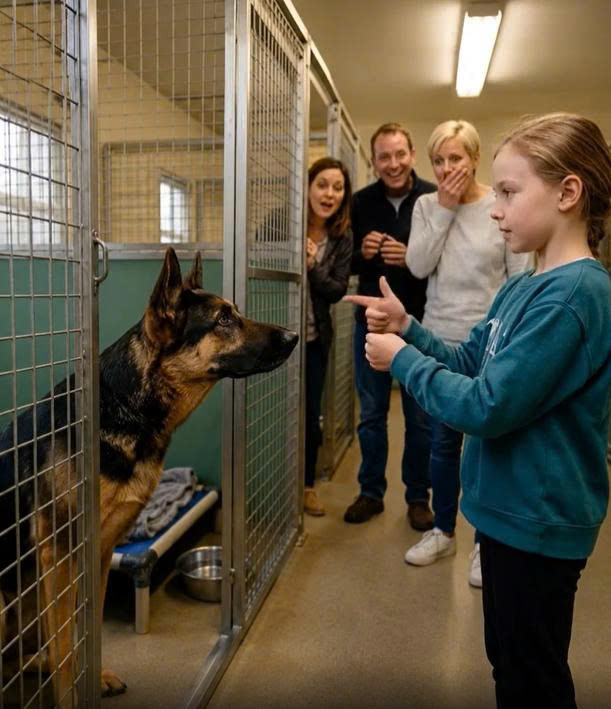
But now she stood frozen in the isolation wing with her clipboard at her feet, watching a ten-year-old deaf girl speak to an unplaceable German Shepherd through chain link.
The girl’s name was Lily Harper.
She knelt on the cold concrete at the far end of the hallway, brown hair falling around her shoulders, knees tucked beneath her, hands moving through the air with slow, precise grace. No voice came from her. No whistle. No clicker. No command any of the shelter staff had ever bothered to try.
Behind the wire of kennel eleven, the German Shepherd obeyed anyway.
Sit.
Down.
Stay.
Come.
Spin.
The dog moved like a soldier remembering his orders after a long war. He sat when Lily’s fingers shaped the word. He lay down when her palm lowered. He stayed still as stone when she held her hand flat. He rose and came forward when her fingers curled toward her body. He turned once, settled again, and watched her hands as if they were the only language in the building that had ever made sense.
Twenty-three children crowded behind Janet, pressed shoulder to shoulder along the hallway walls. Their field trip chatter had vanished. Their mouths hung open. Even the loud boys from the back of the bus stood silent, their bodies suddenly unsure what to do without noise.
Caroline Harper stood beside the peeling gray door, one hand pressed to her mouth.
For ten years, she had watched her daughter reach for the world and find air.
She had watched teachers turn away while speaking. Watched children shout invitations Lily could not hear, then assume her silence meant refusal. Watched doctors praise her for adapting while offering too little worth adapting to. Watched relatives speak louder, as if volume could build a bridge across deafness. Watched strangers call her shy, difficult, delayed, sweet, quiet, brave—everything except understood.
But now the dog in kennel eleven understood.
No one else moved.
Lily signed good dog.
The German Shepherd’s tail swept the concrete once.
Janet’s fingers tightened around nothing.
The clipboard stayed where it had fallen.
Six hours earlier, Lily had woken to vibration.
A small round alarm disc buzzed beneath her pillow, pressed against her cheekbone, shaking her from sleep without sound. She opened her eyes to the gray light of an October morning and watched dust drift slowly across the room.
She did not rush.
There was never any rush when no one called your name.
Downstairs, the kitchen smelled like toast, coffee, and the lemon cleaner her mother used when she was worried. Caroline stood at the counter in her work cardigan, hair clipped loosely at the back of her neck, one hand wrapped around a mug she had not drunk from. When Lily entered, Caroline turned and signed carefully.
Field trip today. Animal shelter. Remember?
Lily nodded.
She remembered.
The permission slip had been on the refrigerator for two weeks, held there by a magnet shaped like a smiling crab from their trip to Virginia Beach years ago. Lily had wanted to feel excited. She liked animals better than people most of the time. Animals did not usually pretend to understand her. They were honest in their confusion. Dogs especially seemed to live in bodies first, voices second.
But wanting something too much had become dangerous.
Excitement required hope.
Hope required the possibility of being met.
Caroline watched Lily eat cereal in small, mechanical spoonfuls.
“You can show them your sign card,” Caroline signed.
Lily glanced toward her backpack.
Inside, buried beneath a crumpled math worksheet and a pencil pouch, was a laminated card with blue letters on a white background.
I am deaf. I use sign language.
Her speech therapist had given it to her in second grade, four years ago. Lily had never shown it to anyone.
She knew what happened when she showed people what she needed.
Their faces changed first. Pity, embarrassment, irritation, determination. Then their hands became too careful, or their mouths became too wide, or their voices became louder, though she could not hear them. For a few minutes, they tried. Then trying became work. Then work became something they forgot.
The card stayed in her backpack.
Caroline saw Lily look away.
Her own hands lowered.
She wanted to say more. She always wanted to say more. Ten years of motherhood had made her fluent in both language and helplessness. She knew how to sign I love you, brush your teeth, where are your shoes, do not touch the stove, I am proud of you. She did not know how to sign, I am so sorry the world keeps making you prove you deserve to be included.
Instead, she packed Lily’s lunch.
On the school bus, Lily sat in the front row alone.
The seat beside her filled with backpacks because children who did not sit with her still found her useful for storage. Behind her, bodies shifted, laughed, bounced. She felt the vibrations through the plastic seat and the metal floor. She saw mouths open and close, faces leaning into one another, eyes bright with shared jokes she would never enter.
Tommy Saunders brushed past her, his elbow catching her shoulder.
His mouth moved.
Sorry, maybe.
Move, maybe.
Nothing, maybe.
He disappeared into a seat three rows back, where three boys welcomed him with wide gestures and noise Lily saw but did not hear.
She turned to the window.
Virginia slid past in muted autumn colors. Pastures bronze with dead grass. White fences. A red barn with a collapsed roof. Cows in muddy fields. A tractor rolling beside a line of pines.
A dog ran alongside the tractor, lean and black, tongue out, ears back in joy.
The man on the tractor turned his head. His mouth shaped something. A whistle? A call? A name?
The dog turned instantly.
Lily watched until the field disappeared behind a rise.
Her hands lay still in her lap.
Pinewood Animal Shelter sat off a county road behind a weathered split-rail fence. The building was smaller than Lily had imagined, a single story with faded green siding, a low roof, and a hand-painted sign swinging from two chains.
PINEWOOD ANIMAL SHELTER
EVERY ANIMAL DESERVES A SECOND CHANCE
Lily read the words twice.
She wondered who decided what counted as a chance.
Inside, the shelter smelled of bleach, kibble, wet fur, old towels, and something anxious beneath it all. Fluorescent lights flickered overhead. Lily could not hear their hum, but she could see the tiny jumps in brightness and feel the vibration faintly in her teeth when she stood still.
Janet Holbrook stood at the front with a clipboard pressed against her chest like armor.
She was in her mid-fifties, tall and straight-backed, gray hair pulled tight into a bun, glasses on a chain around her neck. Her name tag sat crooked on her navy shelter polo. Her mouth moved in efficient shapes.
Welcome.
Rules.
No running.
Do not put fingers through cages.
Stay with your group.
Caroline pushed gently through the cluster of parents and began signing near Lily’s shoulder. Janet paused mid-sentence, frowned slightly, then continued without adjusting her position.
Standard procedure.
Lily knew that look.
The brief confusion. The decision. The carrying on.
She was not being excluded on purpose. That was what adults always explained later, as if accidental exclusion landed softer.
Across the room, an old man caught her eye.
He wore a faded denim jacket, scuffed work boots, and a red flannel shirt buttoned wrong at the collar. White stubble covered his jaw. One knee bent stiffly when he shifted his weight. He pointed to his own ear, then shrugged in a big, theatrical way.
Mine don’t work so great either.
Lily did not smile.
But her shoulders dropped half an inch.
The old man nodded once, then turned away as if he had not done anything important.
Mrs. Patterson, Lily’s teacher, led the class down the main kennel hallway. She had stayed up late learning a handful of signs from online videos, and all morning she had been using them with earnest, clumsy care. Lily appreciated the trying. She also hated that trying looked so visible on Mrs. Patterson and so exhausting on everyone else.
Kennel one held a beagle mix named Buster.
Lily crouched, raised her right hand, and signed sit.
Buster barked at the cluster of boys behind her.
Kennel two held a black Lab spinning in wild circles. Lily signed sit. The Lab followed a volunteer carrying food buckets down the hall.
Kennel three held a white terrier mix that opened and closed its mouth so fast the children covered their ears. Lily signed stay. The dog screamed at a world of sounds she would never enter.
Kennels four through ten gave her the same answer.
Nothing.
Each time, she knelt, signed, waited, rose, and moved on.
Caroline watched from the back of the group with the old ache pressing behind her ribs.
Lily’s face remained still.
She had learned stillness early.
At six, at a birthday party, she watched a magician pull scarves from his sleeve while every child shrieked and clapped. Lily sat in the corner, eyes flicking from moving mouths to quick hands, understanding nothing except that joy could happen in the same room and still leave her outside it. Her face had gone blank that afternoon. Later, Caroline found her sitting alone under the dining table, tracing patterns in carpet dust.
Since then, blankness had become Lily’s shelter.
Kennel ten barked through the wire.
Lily lowered her hands.
Tommy Saunders stood a few kennels behind her, commanding a golden retriever.
“Sit!” he said.
The dog sat.
Tommy puffed his chest. His friends laughed and clapped.
Lily saw his mouth move.
You just have to be loud enough.
The words landed without sound.
You have to be loud.
You have to make noise.
You have to be heard.
She turned away.
At the far end of the main hall stood a gray door marked STAFF ONLY — ISOLATION WING. The paint peeled at the edges. The door did not quite latch. Darkness sat beyond it, still and quiet.
Lily should have gone back to the group.
Instead, she stood before the crack of the door and looked into a silence that seemed, for once, to be waiting with her.
The old man in the denim jacket limped past, pushed the door open, and wedged a brick beneath it.
He looked at Lily.
Then nodded toward the opening.
Then he walked away.
## Chapter Two: Kennel Eleven
The isolation wing smelled different.
Less bleach.
More dust.
Less fear flung outward in barking and jumping.
More fear folded inward.
Lily walked slowly, one hand trailing near—but not touching—the wall. The concrete was colder here. The light dimmer. Several kennels sat empty, their doors chained open. The clipboards beside them hung blank or carried old notes that had curled from damp air.
Kennel one: empty.
Kennel two: empty.
Kennel three: medical hold, cat recovering from surgery.
Kennel four: empty.
Lily kept walking.
Her sneakers made no sound she could hear, but she felt each step through her heels.
At kennel eleven, she stopped.
The German Shepherd sat in the far back corner.
He was large, gray-black, with lighter fur around the muzzle and old scars stitched pale across his snout. One ear stood sharp; the other had a notch missing from the tip. His body was still. Not sleepy. Not defeated. Still in the way a soldier is still when listening for danger.
His eyes fixed on Lily’s hands.
Not her face.
Not the hallway behind her.
Her hands.
The clipboard beside the gate read:
NAME UNKNOWN. INTAKE NAME: DOG 11.
BREED: GERMAN SHEPHERD MIX.
AGE: APPROX. 4–5 YEARS.
NOTES: UNRESPONSIVE TO VOCAL COMMANDS. DOES NOT ENGAGE WITH HANDLERS. POSSIBLE HEARING IMPAIRMENT INCONCLUSIVE.
SCHEDULED FOR TRANSFER TO BEHAVIORAL FACILITY — OCTOBER 15.
Lily read the red line twice.
Transfer.
Behavioral facility.
She did not know exactly what that meant, but she knew how adults wrote soft words around hard decisions.
She looked back at the dog.
He had not moved.
Most dogs looked everywhere. At people’s faces, at food, at the door, at whatever sound pulled them. This dog’s eyes remained on her hands, as if he had been waiting so long for them that looking away would be a betrayal.
Lily’s breath caught.
Slowly, she raised her right hand.
Sit.
The dog was already sitting.
His posture sharpened.
Down.
For one second, nothing happened.
Then the German Shepherd lowered himself to the concrete.
Lily’s heart kicked so hard she felt it in her throat.
Stay.
Her palm flattened.
The dog did not move.
Come.
Her fingers curled inward.
The Shepherd rose, walked to the chain link, and sat directly in front of her.
Their faces were inches apart.
Lily saw the scars clearly now. The white ridge on his muzzle. The notch in his ear. The faint cloudiness in one eye. The gray around his face that made him look older than the clipboard claimed. This dog had lived through something. Maybe many somethings.