The sign should have been easy to ignore.
Maple Ridge had a hundred hand-lettered signs every Saturday afternoon at the flea market. Tools, $5. Baby clothes, half off. Fresh eggs. Antique lamps. Fishing rods. A boy selling lemonade with more optimism than inventory. A woman with jars of honey stacked like amber sunlight under a blue tarp.
But this sign was different.
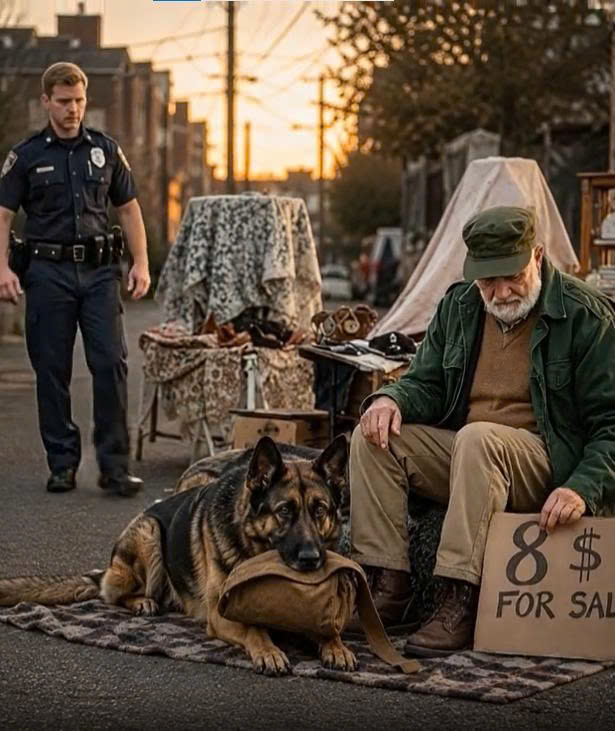
Dog for sale. $8.
The cardboard was bent at one corner, the ink uneven, the words nearly torn loose by the wind.
Officer Jack Monroe stopped in the middle of the cracked parking lot with a box of old woodworking chisels under one arm and a feeling in his chest he could not name.
The late autumn sun hung low behind the northern Colorado hills, turning the pine ridges bronze. Dry leaves skittered across the asphalt. The flea market was beginning to thin as vendors packed unsold things into trucks and trailers, their tarps snapping in the cold. Somewhere, a woman laughed too loudly. Somewhere else, a radio played an old country song about coming home.
Jack heard none of it clearly.
He saw the man first.
The old veteran stood beside a folding table that held almost nothing: two dented camping mugs, a box of paperback westerns, a rusted lantern, and a framed photograph turned facedown against the wind. He was thin in a way that went beyond age. His faded green Army jacket hung loose over his narrow shoulders, sleeves frayed, zipper crooked. A gray wool cap covered most of his white hair. His cheeks were hollow, his lips dry, but his posture still held the ghost of drill yards and commands obeyed long after the body stopped wanting to.
Beside him sat a German Shepherd.
Sable-coated, gray-muzzled, large-boned, and dignified enough to make the entire flea market seem shabby around him. One ear stood high. The other bent slightly outward, scarred at the base. His brown eyes were steady and tired, touched by the old patience of a dog that had learned to wait without expecting much. Around his neck was a clean but faded military-green bandana.
He was not tied.
He did not need to be.
He sat close enough to the old man’s chair that one paw touched the boot beside it.
Jack looked at the sign again.
Dog for sale. $8.
The old man followed his gaze and gave a small, embarrassed smile.
“Afternoon, officer.”
Jack shifted the box of chisels under his arm. “Afternoon.”
The dog watched him.
Jack had been a police officer for sixteen years. Before that, he had been a soldier for eight. He had been looked at by suspects, victims, grieving parents, superior officers, frightened children, dying men, and once by a horse that seemed to personally blame him for an overturned trailer. He knew the difference between a stare and an assessment.
The Shepherd was assessing him.
Hands. Voice. Balance. Intent.
Jack respected him immediately.
He stepped closer, slowly. “Mind if I ask about the sign?”
The old man looked down at the cardboard as if surprised to find it still there.
“Name’s Thomas Reed,” he said. “This here is Rex.”
The dog’s ear flicked at his name, but he did not move.
Jack crouched a few feet away, resting the box of chisels by his boot. “Hello, Rex.”
Rex’s nostrils moved.
Thomas’s fingers tightened around the back of the folding chair. They were thin fingers, shaking faintly. Not from cold alone. Jack had seen tremors like that in veterans trying to hold coffee cups at support meetings, men whose bodies still heard artillery even when their ears did not.
“Eight dollars,” Jack said quietly.
Thomas nodded.
“That’s a strange price for a dog like him.”
A cough seized the old man before he could answer. He turned away, pressing a handkerchief to his mouth. When he lowered it, Jack saw the red specks before Thomas folded it into his palm.
“Not selling him because he’s worth eight dollars,” Thomas said, voice roughened. “Selling him because I need someone to pay something. Just enough that it means he was chosen. Not abandoned.”
The words moved through Jack colder than the wind.
He stood slowly.
“You sick?”
Thomas smiled without humor. “Stage four lung cancer. Doctor says a few months if I behave. I never was good at that.”
Rex leaned his shoulder against Thomas’s leg.
Thomas put one hand on the dog’s head, fingers finding the scarred ear by memory.
“He’s been with me eight years. Came out of a military retirement program after I lost my wife and most of my sense. I didn’t train him from a pup, but he trained me into a man who got out of bed most mornings.” He looked toward the hills. “PTSD is what they call it now. Back when I came home, people just said you were bad at being normal.”
Jack said nothing.
He knew better than to interrupt the shape of a confession.
Thomas looked back at him.
“I can’t walk him right anymore. Can’t afford all his joint medicine. Can’t guarantee I’ll wake up tomorrow to feed him. And he deserves to hear a voice in the morning.”
A woman stepped out from the neighboring booth, where a hand-painted sign advertised pet bandanas and homemade treats. She was in her mid-thirties, petite, sharp-featured, with a brown ponytail tucked beneath a gray beanie and a fleece vest zipped over a plaid shirt. Her eyes were hazel, warm but practical.
“Elise Parker,” she said. “I’m the veterinarian here in town. I’ve treated Rex for a few years.”
Jack nodded. “Officer Jack Monroe.”
“I know.” Her gaze moved to the dog. “He’s older, hips a little stiff, but he’s strong. Smart. Steady. He needs routine and someone who understands that loyalty doesn’t retire cleanly.”
Thomas gave her a faint smile. “She’s been kind enough to keep him patched together when I could barely pay with canned soup.”
Elise’s face tightened. “You brought good soup.”
“Lentil, mostly.”
“Not your best quality.”
Thomas laughed, then coughed again.
Jack looked at Rex.
The dog had not taken his eyes off him.
Behind Jack, a familiar voice spoke.
“That dog is not a weekend project.”
Mia Lopez stood with her arms crossed, dark braid tucked into her jacket, her expression skeptical enough to scrape paint. She was Jack’s partner on the force, early thirties, Latina, compact, sharp-tongued, fiercely loyal, and allergic to sentimental decisions made in public places.
Jack turned. “I didn’t say he was.”
“You’re thinking something.”
“I think most days.”
“Not always well.”
Thomas chuckled softly.
Mia looked at the old man, then at Rex, and her face changed by a fraction. Not softened exactly. Mia softened rarely and disliked being caught at it. But the sharpest edge lowered.
“Sir,” she said, “you sure about this?”
Thomas looked at Rex for a long time.
“No.”
The honesty silenced them all.
Then he added, “But dying doesn’t wait until you’re sure.”
Jack reached for his wallet.
He pulled out eight one-dollar bills and held them in his hand.
The old man’s eyes filled before Jack placed the money in his palm.
“I’m not buying him,” Jack said.
Thomas closed his shaking fingers around the bills.
“No?”
“I’m accepting a brother.”
Thomas swallowed hard.
Rex stood.
Not quickly. Not dramatically. He rose with careful dignity, shook once, and turned to Thomas.
The old veteran crouched slowly with one hand braced against the chair. Rex moved closer, pushing his gray muzzle under Thomas’s chin.
For one long moment, the flea market disappeared.
There was only an old soldier, his dog, and the final bravery of letting love go before death made the decision for him.
Thomas whispered something into Rex’s ear.
Jack did not hear it.
He did not need to.
Then Thomas straightened as much as his body allowed and saluted.
Weakly.
Proudly.
Jack returned the salute without thinking.
Rex sat tall between them, head lifted, eyes forward.
Mia looked away.
Elise wiped quickly under one eye and pretended the wind had done it.
Thomas untied the faded green bandana from Rex’s neck and pressed it into Jack’s hand. Then he reached into his jacket and pulled out a small weathered notebook, its corners soft from years of handling.
“Signal guide,” he said. “Hand commands. Calming notes. Storm triggers. He still remembers more than I do.”
Jack accepted the notebook like a sacred thing.
“I’ll take care of him.”
Thomas nodded.
“I know.”
“How?”
The old man looked at Rex.
“Because he let you come close.”
As Jack walked toward his truck with Rex at his side, the Shepherd paused once and looked back.
Thomas sat in his folding chair under the sinking amber sun, eight dollars in his hand, no dog at his feet, and a peace on his face that hurt to see.
Rex bowed his head once.
Then he turned and followed Jack into the next chapter of his life.
## Chapter Two: The House with the Empty Rug
Jack’s house had not heard dog nails on wood in seven years.
The sound struck him harder than he expected.
Click. Pause. Click-click. Sniff. Click.
Rex entered slowly, taking the place in as if it had to be cleared before it could become home. The house sat at the end of Cedar Road, a modest two-bedroom place with a deep front porch, a woodstove, pine floors, and more silence than furniture. Jack had bought it after his father died because leaving the old shed full of tools felt like abandoning a second grave.
The living room held a threadbare sofa, a coffee table scarred by years of mugs and pocketknives, a folded flag in a glass case above the fireplace, and a faded oval rug near the hearth where Jack’s last dog, Boone, had slept before cancer took him.
Rex stopped at the edge of the rug.
He sniffed it.
Then looked at Jack.
“Yeah,” Jack said quietly. “Someone lived here before you.”
Rex stepped onto the rug, circled once, and sat facing the front door.
Not relaxed.
On watch.
Jack set Thomas’s notebook on the coffee table and removed the green bandana from his coat pocket. It smelled faintly of cedar smoke, old wool, and something medicinal. Rex’s eyes followed it.
“Yours,” Jack said.
He tied it loosely around the dog’s neck.
Rex exhaled and lowered his head, as if the weight of the cloth had steadied him.
Jack fed him in the kitchen. He set down the bowl, then remembered the notebook and flipped through until he found the feeding note.
Release: “Okay, soldier.” Do not use “free.” That was field release and may trigger search posture.
Jack looked at Rex.
“You really came with instructions.”
Rex waited.
Jack set the bowl down.
“Okay, soldier.”
Rex ate.
No grabbing. No frantic hunger. Measured, steady, disciplined.
When he finished, he carried the empty bowl carefully in his mouth and placed it beside Jack’s boot.
Jack stared.
Then opened the notebook.
Will bring bowl when done. Do not praise too loudly. He considers food a mission.
Jack laughed.
It startled him.
The sound left his chest rusty and unfamiliar.
Rex’s tail moved once.
That night, the ambulance siren came from the highway.
Distant.
Fading.
Still enough.
Rex shot up from the rug, eyes wide, ears locked, body trembling. He did not bark. The silence was worse. His chest heaved as if the living room had become something else entirely: a convoy road, a field hospital, a firefight, a memory with teeth.
Jack was out of bed before the siren faded.
He did not turn on the lights. He sat on the floor beside Rex, cross-legged in sweatpants and an old academy shirt, and opened the notebook by the glow of the woodstove.
Siren panic: sit low, no sudden touch. Breathe audibly. Say “home now.” Offer right shoulder contact if he comes to you.
Jack laid his hands on his knees.
Inhale.
Exhale.
Rex paced once, then again, eyes fixed on the door.
“Home now,” Jack said softly.
The dog turned.
“Home now, Rex.”
Another breath.
Rex took one step toward him.
Then another.
Jack did not reach.
Rex pressed his shoulder against Jack’s arm.
The dog’s body shook.
Jack matched his breathing to the old Shepherd’s uneven rhythm until both of them slowed.
For the first time in years, Jack remembered the night his own convoy hit an IED outside Kandahar. Not the blast. He always remembered the blast. What he had forgotten was the medic sitting beside him afterward, not saying anything important, simply breathing loudly enough for Jack to follow.