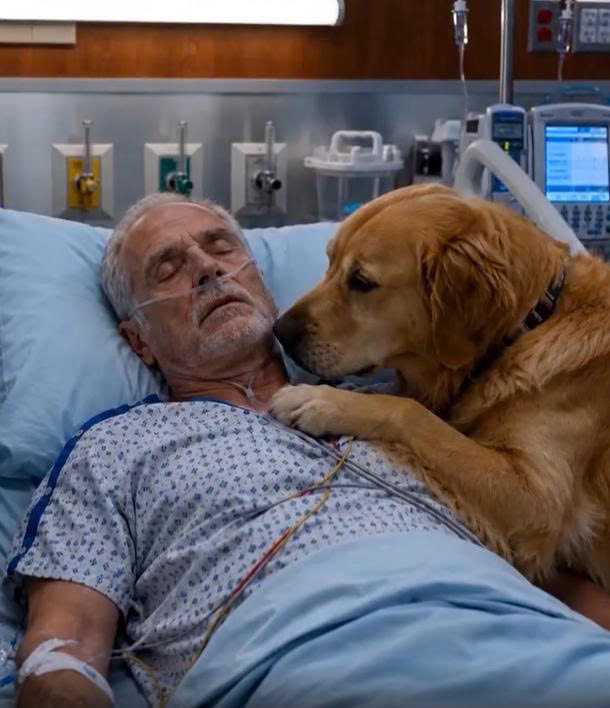
For three days, Jonathan Miller lay between life and death, whispering the same name no one in his family recognized.
At first, the doctors thought it was a reflex.
A meaningless movement of lips beneath the oxygen mask.
The kind of sound bodies made when the mind had gone somewhere too deep for language to follow.
Jon had been brought into St. Mercy General on a rainy Monday morning after collapsing beside his workbench at Miller & Sons Auto Repair, though the shop had not belonged to anyone named Miller for nearly twenty years. He was forty-seven years old, broad-shouldered, hard-handed, and the kind of man who apologized to chairs when he bumped into them.
His heart had stopped once in the ambulance.
Then again in the emergency room.
By the time his wife Sarah arrived, a nurse in blue scrubs was guiding her toward the ICU with one hand at her elbow and a voice too gentle to be good news.
“He’s alive,” the nurse said quickly, because Sarah’s knees almost failed before they reached the elevator. “He’s critical, but he’s alive.”
Alive.
That word became the thin rope Sarah held for the next seventy-two hours.
Alive while machines breathed with him.
Alive while tubes ran into his arms.
Alive while a monitor translated the private stubbornness of his heart into green lines and small electronic beeps.
Alive while their sixteen-year-old daughter, Emily, sat beside the bed with her backpack still on, eyes swollen from crying, whispering, “Dad, I’m here,” over and over as if attendance could pull him back.
Alive while Jon’s older brother Michael stood by the window with his arms crossed, trying to look like the kind of man families leaned on, even though the muscles in his jaw kept jumping.
Alive while Sarah held her husband’s hand and realized, with a terror that felt almost childish, that she did not know what to do if the hand stopped being warm.
On the first night, Jon began whispering.
Sarah was half asleep in the vinyl chair beside him when she heard it.
A rough, wet murmur under the mask.
She sat upright so fast the blanket fell from her lap.
“Jon?”
His eyelids did not move.
The ventilator sighed.
His lips shifted again.
“Ma…”
Sarah leaned close, her heart slamming.
“What, honey? What did you say?”
The sound came again, barely there.
“Ma… lo…”
She froze.
“Michael?”
Her brother-in-law, who had been dozing near the window, jerked awake.
“What?”
Sarah looked at him.
“I think he said your name.”
Michael came to the bedside, face pale beneath his beard.
“Jon?”
Jon’s lips moved.
“Mmm… lo…”
Michael bent lower.
“Buddy, it’s Mike. I’m here.”
Nothing.
Only the machines.
Then the murmur again.
“Ma… lo…”
Michael straightened slowly.
“That isn’t my name.”
Nurse Carla, who had worked ICU long enough to hear every variety of grief and denial, came in to check the monitor.
“He may not be forming real words,” she said gently. “Sometimes patients in this condition vocalize without conscious meaning.”
Sarah wanted to hate her for saying it.
She could not.
Carla’s eyes were too kind.
By morning, everyone had an opinion.
One nurse heard “Max.”
Another heard “Miles.”
Emily thought maybe he was saying “Mom,” though Jon’s mother had died when he was twenty-two.
Michael wondered if it was someone from the shop.
Sarah sat with her ear close to the mask and heard only a name that seemed to come from a place in him she had never been allowed to enter.
“Milo,” she whispered once, testing the shape.
Jon’s fingers did not move.
His lips did.
“Milo.”
The sound was clearer that time.
Clear enough that Sarah pulled back as if the word had touched her.
“Who is Milo?” Emily asked from the foot of the bed.
Sarah looked at her daughter.
“I don’t know.”
The answer embarrassed her.
It should not have.
A person could be married twenty-one years and still not know every name buried inside the person beside them. Sarah knew Jon’s coffee order, the brand of work boots that did not hurt his knees, the way his left shoulder clicked when rain was coming, the songs he hummed when he thought no one was listening, the exact way he folded cash in his wallet.
She knew he pretended not to cry during old baseball movies.
She knew he hated peas but ate them because Emily liked them.
She knew he checked the locks every night in the same order.
She knew he had been quieter that year.
Too quiet.
But she had not known Milo.
That was what frightened her.
Not jealousy.
Not really.
Something worse.
The possibility that her husband had been calling for help long before his heart gave out, and she had not known the language.
By the third day, Jon’s numbers were worse.
The ICU had a way of teaching hope humility. One hour, oxygen rose. The next, blood pressure slipped. A doctor might say “encouraging” at nine and “guarded” at noon. Families learned to read eyebrows, pauses, the number of people entering a room together.
Dr. Harrison, a tall man with silver hair and tired eyes, stood at the foot of Jon’s bed on Thursday morning and told Sarah the truth carefully.
“We are doing everything medically appropriate,” he said. “But his body is tired. The neurological response is limited. I don’t want you to lose hope, but I need you to understand where we are.”
Sarah nodded.
She did not understand.
Or she did, and understanding was unbearable.
Emily stood beside her mother, arms wrapped tightly around herself.
Michael looked at the floor.
Jon whispered again.
“Milo.”
Dr. Harrison heard it that time.
His expression changed just slightly.
“He has been saying that consistently?”
“For three days,” Sarah said. “We don’t know who it is.”
Dr. Harrison looked at the monitors.
“Sometimes the mind holds onto something emotionally significant. A person. A place. A memory.”
“A secret?” Emily asked.
No one answered.
That afternoon, Ray Donnelly came to the hospital carrying Jon’s work jacket in a plastic bag and a cardboard box of personal things from the shop.
Ray owned Miller & Sons Auto Repair now. He had bought it from old Frank Miller before Jon started there, kept the name because the sign was already paid for, and hired Jon because he had the hands of a mechanic and the patience of a priest.
Ray was sixty, heavyset, gray at the temples, with oil permanently tattooed into the lines of his palms. He wore a flannel shirt under a denim jacket and looked as uncomfortable in the ICU as a tractor parked in a chapel.