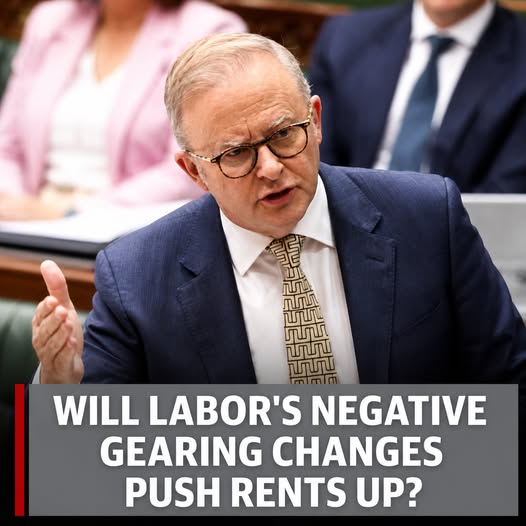
Australians are increasingly questioning Labor’s claim that controversial housing tax changes will only push rents up by around $2 a week, with many saying the figure simply does not match what they are already experiencing in the real world.
As rental pressure continues hammering households across the country, the debate has rapidly evolved into something much bigger than tax policy.
It is becoming a battle over trust.
Because once voters stop believing the numbers coming from government modelling, every future promise becomes harder to sell.
That is exactly why the argument is gaining so much momentum.
The issue is no longer just about rents.
It is about whether Australians believe official forecasts at all.

Growing numbers of Australians are questioning government predictions that housing tax reforms will have only a modest impact on rents.
The controversy exploded after government ministers defended modelling suggesting the impact of the proposed housing tax changes would average roughly $2 a week in additional rent pressure.
Critics immediately pushed back.
Many renters, landlords and property industry figures argued the estimate sounded disconnected from what is already happening across Australia’s housing market.
For households that have watched rents jump by hundreds of dollars a month over recent years, the idea of measuring future increases in single-dollar amounts has been met with widespread skepticism.
That skepticism is becoming one of the most politically dangerous parts of the debate.
Housing has become one of the most emotional issues in Australia.
Almost everyone feels connected to it.
Renters worry about affordability.
Homeowners worry about mortgage pressure.
Investors worry about changing rules.
First-home buyers worry about ever entering the market.
Because housing affects so many Australians directly, even small policy changes quickly attract major attention.
And when trust enters the conversation, that attention often turns into political pressure.
The government insists the reforms are being misrepresented.
Ministers argue existing negatively geared properties are largely protected and say there is no immediate justification for widespread rent hikes linked directly to the changes.
That defence has done little to calm the argument.
In fact, the more the $2 figure is repeated, the more public debate appears to intensify.
Many Australians are now focusing on a simple question.
If rents have surged dramatically under existing conditions, why should anyone believe future increases will remain so small?
That question sits at the centre of the growing backlash.
Property groups have warned the real impact could be significantly higher over time if investors pull back from the market or future housing supply slows.
Housing advocates reject those claims and argue some industry groups are deliberately exaggerating the risks.
The result is a public battle filled with competing forecasts, competing modelling and competing warnings.
For ordinary Australians trying to pay rent, the technical details are becoming almost secondary.
What matters is whether housing becomes more affordable.
And many remain unconvinced that outcome is coming anytime soon.
The timing is also creating additional pressure for the government.
Cost-of-living concerns remain one of the biggest issues facing households.
Electricity bills remain high.
Groceries remain expensive.
Insurance costs continue climbing.
Housing sits at the centre of all those frustrations.
That reality means voters are paying close attention to every promise connected to affordability.
Any claim that sounds unrealistic risks attracting immediate scrutiny.
Political strategists understand how dangerous that can become.
Once a debate shifts from policy details to credibility, controlling the narrative becomes much harder.
People may disagree over economics.
They may disagree over tax policy.
But everyone understands the concept of trust.
That is why the current argument is proving so powerful.
Critics are no longer focusing solely on the mechanics of negative gearing or capital gains tax.
Instead, they are framing the issue around whether Australians can believe the assurances being given.
That approach broadens the audience dramatically.
People who have never read a tax policy document can still have strong opinions about whether political promises sound believable.
The government insists the modelling is sound and that opponents are running a scare campaign.
Opponents argue voters are being asked to ignore what they are seeing with their own eyes in the housing market.
Neither side appears willing to back down.
Which means the argument is likely to continue growing.
The longer housing affordability remains under pressure, the harder it becomes for any government to convince voters that modest forecasts reflect reality.
And that may be the biggest challenge Labor faces.
Not defending the policy itself.
But convincing Australians that the numbers attached to it can still be trusted.
Because once trust becomes part of the housing debate, every future promise faces a much tougher audience.