Deputy Jack Reynolds first saw the old man through a veil of blowing snow.
At a distance, he looked like one more grave marker in the cemetery—dark, bent, half-buried beneath the white. The headlights of Jack’s patrol SUV swept over him and then slid past, catching rows of stone, frost-laced pine branches, and the iron fence that ringed North Ridge Cemetery like a warning. Jack almost kept driving. He had only come up the ridge because Ranger had begun growling three streets back.
Ranger never growled at ghosts.
The German Shepherd sat rigid in the passenger seat, black-and-sable coat catching the dashboard glow, amber eyes fixed beyond the windshield. His ears were forward, his chest vibrating with that low warning sound Jack had learned never to ignore.
“What is it, boy?”
Ranger did not look at him.
Snow drifted down in fine white threads over Silver Pines, Colorado, turning the mountain town into something too beautiful to trust. Below the cemetery ridge, the valley glowed with scattered windows and yellow streetlights blurred by storm. Every roof wore snow. Every pine bowed under ice. The whole world seemed muffled, as if God had pressed a hand over it and told it to listen.
Jack slowed at the cemetery gate.
Ranger’s growl deepened.
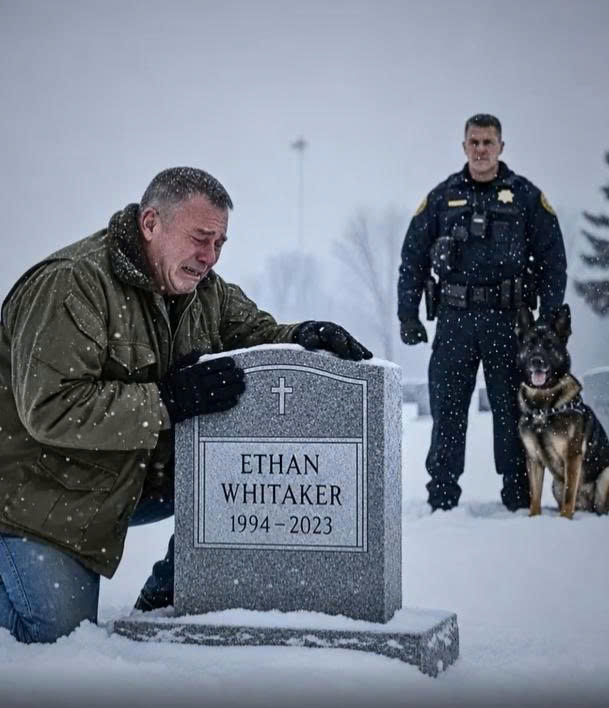
Between two rows of headstones, a figure knelt before a fresh grave.
Jack’s breath fogged the windshield.
He put the SUV in park and shut off the engine.
For a second, he sat still. The sudden silence inside the vehicle was nearly physical. Only the tick of the cooling engine and Ranger’s measured breathing remained.
Jack was thirty-seven, but the winters in his body were older. A former Marine, now a deputy in Silver Pines, he carried his grief the way he carried his sidearm—close, controlled, always there. His storm-gray eyes missed little. His jaw had the hard line of a man who had survived enough to stop believing survival made him special.
He opened the door.
The cold hit first.
Then the sound.
Not sobbing exactly. Something lower. Ragged. A voice speaking to the dead because the living had become useless.
Ranger leapt down and stood beside him, nose lifted to the wind.
“Easy,” Jack murmured.
Together they entered the cemetery.
Snow squealed under Jack’s boots. The wind cut through his navy winter patrol jacket, under the collar, beneath the Kevlar vest. His badge glinted dull gold when the beam from his flashlight crossed it. Ranger moved slightly ahead, not pulling, just leading, nose low now, body tense.
The kneeling man did not turn when they approached.
Jack recognized him before he saw his face clearly.
Samuel Whitaker.
Sam.
Sixty-two years old, retired Marine sergeant, widower, mechanic, father of Officer Ethan Whitaker—the young deputy they had buried the day before under a story everyone had accepted because accepting it was easier than naming the wrongness in the air.
Ethan Whitaker.
Twenty-nine.
Quick grin. Nervous energy. Too eager to stay late. Too stubborn to drop questions when supervisors told him the answers were above his pay grade.
Dead after what the department called a mountain climbing accident.
Jack had stood at the funeral in dress uniform, Ranger sitting at his side, and listened while Chief Alan McCready spoke about tragedy, risk, and the cruel unpredictability of the mountains.
But Ethan had hated climbing.
Jack knew that.
So had half the department.
No one said it out loud.
Sam Whitaker’s gloveless hands gripped the temporary grave marker until his knuckles looked blue. Frost clung to his close-cropped gray hair. His olive drab field jacket hung loose over a body that grief had already begun to hollow.
“Sam,” Jack said gently.
The old man lifted his head.
His eyes were red-rimmed and fever-bright.
“I know who you are,” Sam said. “You worked with my boy.”
Jack took one step closer, then stopped. “You shouldn’t be out here without gloves.”
Sam gave a small, broken laugh. “That your first concern?”
“It’s the one I can solve fastest.”
Sam looked back down at the grave.
The marker read:
ETHAN WHITAKER
BELOVED SON. OFFICER. FRIEND.
1995–2024
Fresh earth lay beneath the snow, not yet frozen over. Someone had left a small American flag beside the marker. Its edge snapped in the wind.
Ranger approached the grave slowly.
He sniffed near the base of the marker, then the disturbed earth, then the snow beside Sam’s knee. His tail stiffened.
Jack caught the scent then.
Faint.
Sharp.
Not floral. Not cemetery soil. Not the sourness of grief and cold clothing.
Something chemical.
Burned residue, maybe. Acidic. Metallic.
Ranger lowered his head and huffed against the snow.
Sam’s voice came rough. “They said he fell.”
Jack said nothing.
“They said he went climbing alone.” Sam turned his face toward him. “My boy hated cliffs. Hated heights. Wouldn’t even climb the ladder to clean my gutters without cursing the roofline.”
Jack’s throat tightened.
“I know.”
Sam’s face twisted. “Do you?”
The words were not accusation only. They were plea.
Jack crouched slowly, resting one gloved hand on Ranger’s back.
“I know enough to have questions.”
Sam looked at him then.
The wind moved between them.
“He told me,” Sam whispered. “If anything happened, it wouldn’t be an accident.”
Jack went still.
Ranger pressed closer to the old man.
Sam’s fingers loosened from the marker and sank into the Shepherd’s fur. Ranger did not move. He stood steady against the grief shaking through the man’s hand.
“What was Ethan investigating?” Jack asked.
Sam closed his eyes.
“I don’t know all of it. Contracts. Payments. Road work. Snow clearance. Fuel supply. Something called Coyote.” He swallowed. “He said the rot was inside the department.”
The word moved through Jack like a blade.
Coyote.
He had heard Ethan say it once, maybe twice, in the breakroom after midnight. Half-joking, half-not, as he scribbled in a yellow legal pad and lowered his voice whenever someone passed too close.
Follow the coyote, he had said.
Jack had dismissed it as Ethan being Ethan—young, intense, always chasing smoke.
Now smoke had become a grave.
Sam reached into his coat with stiff fingers and pulled out a folded scrap of paper sealed inside a plastic sandwich bag. “He told me if he died, I’d find a sign. I found this tucked under the flag this morning.”
Jack took it.
Inside, on wet paper, in Ethan’s tight handwriting, was one word.
COYOTE.
Ranger sniffed the bag and whined softly.
Jack looked at Sam.
“You said the rot was inside the department.”
Sam’s jaw hardened.
“My house was searched after the funeral.”
“When?”
“Last night. No forced entry. Desk drawer picked. Locked box opened.”
“What was taken?”
“A USB drive Ethan gave me two weeks ago.”
Jack looked sharply at him.
Sam’s eyes filled. “He said it was proof. He made me swear not to plug it into any computer unless he told me to. Said if he disappeared, I should give it to someone clean.”
“Why didn’t you tell me this yesterday?”
“Because I didn’t know who was clean.”
That landed.
Hard.
Honest.
Ranger leaned his weight against Sam’s leg, and the old Marine’s face folded for one helpless second.
“He was my son,” Sam said. “They stood in front of his coffin and lied.”
Jack looked down at Ethan’s grave, then across the dark cemetery rows toward the sleeping town below.
He had promised himself after Afghanistan that he would not chase every ghost that called his name. Then after joining the sheriff’s office, he promised himself again: do the job, go home, don’t let the dead set your agenda.
But promises made to survive were not always promises worth keeping.
Ethan had been his colleague.
His friend, maybe, though men like Jack often recognized friendship only after the other person was no longer there to embarrass them with it.
He folded the paper and placed it inside his inner jacket pocket.
“I’m going to take you somewhere safe tonight.”
Sam shook his head. “I’m not running.”
“No. You’re staying alive.”
Sam stared at the grave.
Ranger lifted his head suddenly.
His ears sharpened toward the tree line.
Jack turned.
Nothing but snow and pines.
Still, every muscle in him answered the dog’s warning.
“We leave now,” Jack said.
Sam let Ranger guide him upright. The old man’s knees nearly buckled, but the Shepherd pressed against him, steady and warm, refusing to let him fall.
As they walked back through the cemetery, Jack glanced once over his shoulder.
Ethan’s grave stood alone under the oldest pine, snow already softening their footprints.
But the word in Jack’s pocket burned like a coal.
Coyote.
Not a clue.
A trail.
And somewhere in Silver Pines, someone had already killed to hide where it led.
## Chapter Two: The Safe House That Wasn’t
The road down from North Ridge Cemetery disappeared twice beneath sheets of windblown snow.
Jack drove slowly, one hand on the wheel, the other resting near the center console where his radio sat quiet. Sam Whitaker sat in the back, hunched forward, both hands wrapped around the hot coffee Jack had poured from the thermos in the cargo space. Ranger had refused the passenger seat and climbed into the rear beside Sam, pressing his flank against the old man’s knee.
Jack watched them in the mirror.
He had seen Ranger calm frightened children, angry drunk men, crash victims, and one terrified calf trapped in a culvert during spring flooding. But with Sam, the dog acted differently. Not working. Not performing. Holding.
The old Marine stared through the side window at the dark pines.
“They’ll say I’m crazy,” Sam said.
“No.”
“They will. Grieving father. Old combat vet. Sees enemies because he can’t accept a fall.”
Jack kept his eyes on the road.
“Maybe.”
Sam laughed once, bitterly. “That supposed to comfort me?”
“No. It’s supposed to prepare you.”
Ranger lifted his head.
Jack glanced at the dog. “But I believe you.”
Sam turned toward the mirror.
For a moment, he looked younger than grief had made him.
Then older again.
“Why?”
Jack thought of Ethan’s yellow legal pad. The quiet conversations. The way he had changed in the weeks before his death—not afraid, exactly, but watchful. Jack had seen that look on men who were carrying information heavier than their rank.
“Because Ethan didn’t make noise unless there was something under it.”
Sam closed his eyes.
The words seemed to hurt him and help him at once.
Instead of taking Sam home, Jack drove to a boarding house on Cedar Street owned by Mrs. Jane Kesler, a seventy-five-year-old retired schoolteacher with silver hair pinned into a knot and the calm authority of a woman who had disciplined entire generations into using complete sentences. Her husband had been a deputy thirty years earlier, killed in a snowplow accident during a rescue call. Jane kept a quiet room upstairs for people who needed to disappear without anyone naming it.
She opened the door in a flannel robe before Jack knocked twice.
“Samuel,” she said, looking past Jack. “Come in before the mountain takes the rest of you.”
Sam stood in her hallway, snow melting off his boots.
Jane looked at Jack. “Trouble?”
“Yes, ma’am.”
“How much?”
“Enough.”
She nodded once. “Room three. Back stairs if anyone comes. I still keep a shotgun behind the linen closet.”
Sam said, “Jane—”
She held up one hand. “Don’t make me mother you in front of law enforcement.”
He closed his mouth.
Ranger walked Sam upstairs, then came back down reluctantly.
Jack crouched near the door and gripped the dog’s collar.
“You want to stay with him?”
Ranger’s ears moved.
“I know.”
But Ranger also knew duty. He returned to Jack’s side, though he looked back once toward the stairs.
Outside, snow had thickened.
Jack and Ranger sat in the idling SUV half a block away. Jack powered off his department phone and pulled a burner from the glove box, one he kept for off-grid emergencies after years of not trusting modern convenience with old instincts.
He called the one person Ethan had mentioned months ago in a sentence Jack now regretted ignoring.
Lisa Grant answered on the fifth ring.
“Who is this?”
“Jack Reynolds.”
Silence.
Then: “Took you long enough.”
Jack shut his eyes briefly. “You knew I’d call?”
“I hoped Ethan wasn’t wrong about you.”
Jack looked toward Jane’s boarding house. “He told you to contact me?”
“He told me if anything happened to him, you were one of maybe two people in Silver Pines who still noticed when official stories smelled bad.”
Jack almost smiled.
Almost.
“Meet me at Maple Diner. Midnight. Bring what you have.”
“No. Too public.”
“At midnight in a blizzard?”
“Public is a state of mind.”
“Reporter humor?”
“Survival humor.” She paused. “Old farmers market lot. Ten minutes north of town. One hour.”
“You followed?”
“No,” Lisa said. “But if you’re calling from a burner, someone else probably is.”
She hung up.
Jack sat still for a moment.
Ranger whined softly.
“Yeah,” Jack said. “She’s going to be a problem.”
The old farmers market lot lay beneath a row of skeletal wooden stalls, their roofs sagging under snow. In summer, the place smelled of peaches, hay, coffee, and warm asphalt. Tonight it smelled of ice, old wood, and exhaust from Lisa Grant’s battered Subaru.
She stood beneath one of the stalls in a navy parka, camera bag across her shoulder, curly chestnut hair pinned back under a wool cap, glasses fogging at the edges. She was thirty-two, sharp-eyed, narrow-faced, and carried tension like a second spine.
Ranger sniffed her first.
Jack trusted the dog’s assessment more than his own, which was currently irritated.
Ranger circled her once, sniffed her boots, then sat.
Lisa looked down. “Approved?”
“For now,” Jack said.
She reached into her coat and pulled out a folded map.
“Ethan sent me this four days before he died.”
Jack unfolded it under his flashlight.
Mountain Pass. Route 217. Snow maintenance zones. Fuel depots. Contractor yards. Three locations circled in red ink.
PINE JUNCTION GAS
OLD COUNTY SALT SHED
NORTH RIDGE TRAILHEAD
Beside the circles, one word.
COYOTE.
Jack felt the paper in his jacket pocket grow heavier.
“What did he tell you?”
“That county contracts for snow removal and mountain-pass safety were being used to move money. Fuel purchases inflated. Chemical shipments mislabeled. Private security firms paid for hazardous-materials escort on routes that didn’t require it. He thought someone in the sheriff’s office was approving ghost invoices.”