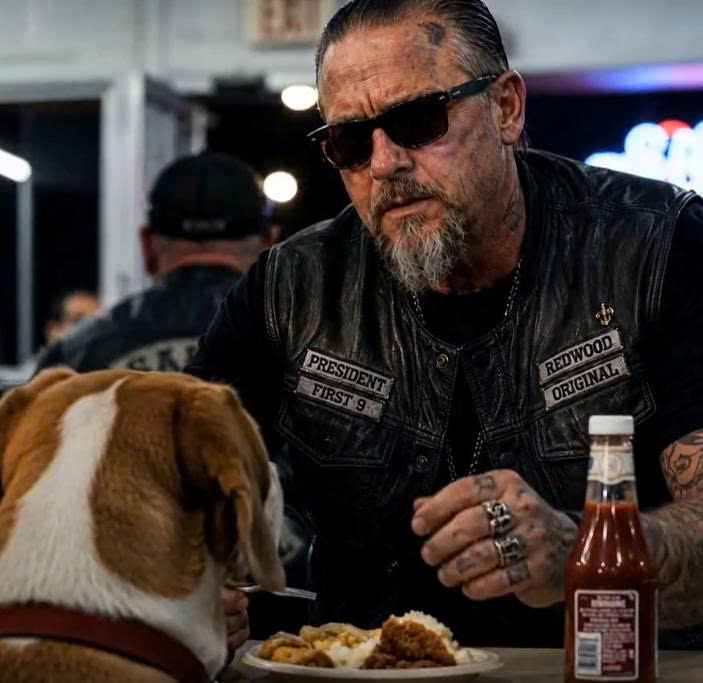
The jukebox in the corner was playing an old Johnny Cash song with a scratched chorus. Coffee steamed in chipped mugs. Rain slid down the windows in silver ropes. Outside, a line of motorcycles sat under the yellow parking-lot lights, chrome wet, black seats shining, engines ticking softly as they cooled.
It was a little after midnight on Highway 17, two miles outside a town called Mercer Falls, the kind of place truckers passed through, teenagers escaped from, and old men claimed was better before the interstate took the traffic away.
Jake Callahan sat in the back booth with his coffee untouched.
He always took the same booth.
Back to the wall.
View of the door.
Right hand free.
Old habit.
Bad habit.
Survival habit.
At forty-eight, Jake looked like a man the road had carved and then forgotten to smooth. Broad shoulders. Weathered face. Gray threaded through his dark beard. A scar above his left eyebrow from a bottle thrown in a bar twenty years ago. Another on his right forearm from a house fire he still smelled in his dreams.
His leather vest lay on the seat beside him, heavy with old patches from a riding club called the Black River Saints.
Not an outlaw gang.
Not saints either.
Just men and women who had lost enough, ridden far enough, and learned that sometimes strangers on motorcycles became more honest family than blood ever managed to be.
Around him, the Saints filled three booths and half the counter.
Sam Briggs sat near the window, silent as always, hands wrapped around a mug the size of a soup bowl. He was sixty-three, built like a barn door, with a gray beard and eyes that missed nothing.
Tommy Reyes, the youngest at twenty-six, was telling a story too loudly about almost dropping his bike in gravel near Tulsa.
“Almost?” muttered Deacon, an old mechanic with tattoos older than Tommy. “Boy, I saw gravel win.”
Laughter rose.
Not Jake’s.
Jake had learned to sit inside laughter without joining it.
That was another habit.
Then the diner door opened.
Rain blew in.
Cold air swept across the floor.
And a small, filthy dog stood on the threshold, ribs showing beneath soaked fur, sides heaving, paws muddy, eyes fixed on the room as if he had searched every light in the county and chosen this one.
Conversation died in pieces.
First the counter.
Then the front booth.
Then Tommy, still holding one hand in the air mid-story.
The dog did not bark.
He stood there trembling, water dripping from his muzzle, one ear torn at the edge, a red collar hanging loose around his neck.
His eyes looked almost human.
Not because they were pretty.
Because they carried the unbearable exhaustion of a creature who had already seen people fail him and had come anyway.
Miller’s Diner had seen drunks, fugitives, runaway teenagers, stranded tourists, lonely widows, truckers crying quietly over meatloaf, and one county commissioner who once tried to fight a vending machine.
But nobody moved when that dog came in.
Not until Jake did.
He slid out of the booth slowly.
The old leather seat creaked beneath him.
“Easy,” he said.
The dog’s eyes snapped to him.
Jake stopped ten feet away and lowered himself to one knee.
Everyone watched.
Nobody spoke.
Jake held out his hand, palm down, not reaching.
The dog stared at it.
Rainwater dripped from his chin to the tile floor.
Then, without hesitation, he came forward and buried his muzzle in Jake’s palm.
A sound moved through the diner.
Not a gasp exactly.
Something softer.
Even Deacon looked away, pretending to study the sugar packets.
Jake felt the dog’s whole body shaking beneath his hand. He was small, maybe twenty-five pounds, some kind of terrier mix with shepherd coloring and a tail tucked tight under him. Beneath the mud, his fur was soft in patches and matted in others. His heartbeat hammered against Jake’s fingertips.
“Where’d you come from, little man?” Jake whispered.
The dog looked up at him.
Then backed away.
One step.
Two.
He turned toward the open door.
Looked back at Jake.
Whined.
Tommy stood.
“He wants you to follow him.”
Jake did not answer.
The dog ran out into the rain, stopped under the light outside, looked back through the glass, then ran back inside. He pushed his wet nose into Jake’s hand again, then spun toward the door.
Again.
Again.
A message in a language no one needed translated.
Sam stood.
When Sam Briggs stood, men noticed.
“Animals don’t walk into places like this by accident,” he said.
Jake looked at him.
Sam nodded toward the door.
“He picked you.”
Jake’s jaw tightened.
That was the problem.
Things that needed saving had always picked him.
A dog.
A burning house.
His younger brother at fourteen, bruised and drunk behind their father’s garage.
His wife, Annie, the night she finally admitted the cancer had moved into her bones.
His daughter, Grace, who had once climbed into his lap at five years old and said, “Daddy, you’re the only one who knows how to make monsters leave.”
Jake had not made the last monster leave.
A drunk driver had crossed the center line outside Wichita seven years ago and taken Annie and Grace before Jake ever got to say goodbye.
Since then, he had spent his life moving.
Ride.
Eat.
Work odd jobs.
Sleep badly.
Never stay long enough for anyone to need him too much.
Now a wet dog stood at the door of a midnight diner, begging with eyes that had not given up.
Jake exhaled.
“All right,” he said.
The dog straightened.
As if the words had opened something in him.
Jake grabbed his vest from the booth.
Sam was already moving.
Tommy too.
“Stay here,” Jake said.
Tommy looked offended.
“No.”
Jake turned toward him.
The kid’s eyes were bright with fear and stubbornness.
“You don’t know what’s out there,” Jake said.
Tommy swallowed.
“Neither does he.”
He nodded at the dog.
Sam put on his gloves.
“I’m going.”
One by one, the others stood.
Not all.
Enough.
Deacon.
Mira, a nurse from Phoenix who rode a matte-black Indian and carried trauma she made useful.
Big Rob, who rarely spoke but had once lifted a truck bumper off a trapped man with his bare hands.
Eight bikers.
A scared dog.
A road in the rain.
Jake looked at the dog.
“Show me.”
The dog turned and ran.
## Chapter Two
### The Blue Bag
The dog did not run blindly.
That was what scared Jake.
He had expected panic, erratic movement, a trail broken by confusion.
But the dog knew exactly where he was going.
He cut across the parking lot, past the line of motorcycles, through a gap in the split-rail fence, and onto a narrow path that led toward the dark tree line behind the diner.
Jake followed on foot first.
Sam came behind him with a flashlight.
The beam cut through rain and branches, showing wet leaves, mud, tire ruts, and the quick flash of the dog’s tail ahead.
“Wait,” Jake called.
The dog stopped.
Looked back.
Waited.
Then moved again.
Smart.
Too smart for a stray.
The path dipped into a shallow creek bed. Rainwater ran cold over Jake’s boots. The dog splashed through, scrambled up the other side, and stopped near a thicket of blackberry canes at the edge of the woods.