That was what Grace Holloway told herself at first, because the alternative—that a creature so small had already learned shame—was too much to carry on a Monday morning in December.
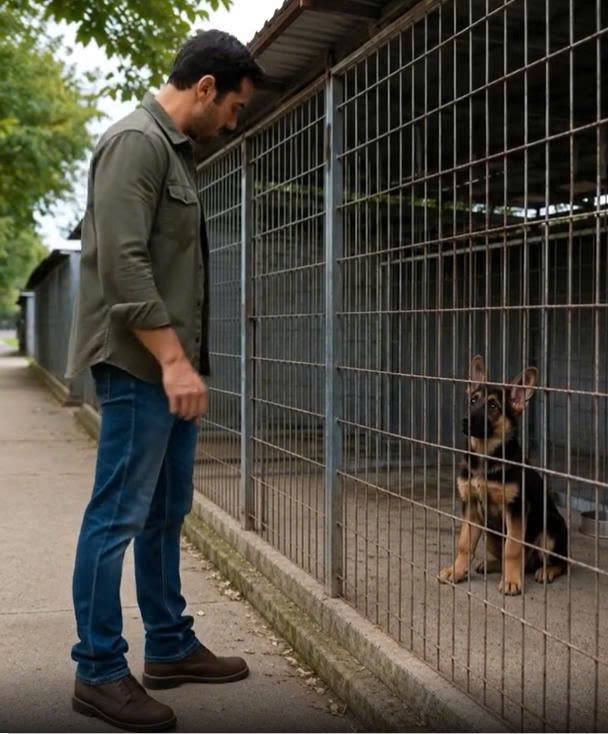
He sat in the last kennel on the left, where the heating vent worked only when it felt charitable and the concrete floor held the cold like a memory. His cage card said MAX in thick black marker, though no one knew if that had been his name before he came in. He was a German Shepherd puppy, maybe four months old, all oversized paws and narrow ribs beneath a coat that should have been black and tan but had gone dull from road dirt, bad weather, and the kind of sadness that seemed to live under the skin.
His ears were not quite up yet. One stood stubbornly. The other folded at the tip like it was too tired to finish growing.
Every morning, Grace unlocked the kennel wing at six-thirty, and every morning, Max sat facing the door.
Not sleeping.
Not playing.
Not chewing the rubber bone Nora had brought him.
Waiting.
The other dogs woke with the usual storm of sound. Barking, yipping, paws rattling gates, tails thumping plastic beds. Daisy the beagle howled as if every sunrise was an injustice. Captain, the old pit mix with one cloudy eye, gave two ceremonial woofs and then went back to sleep. The terrier puppies in kennel seven threw themselves at their food bowls with the violence of tiny, joyful vandals.
Max only watched the door.
“Morning, sweetheart,” Grace said.
He did not wag.
She knelt outside his kennel with the breakfast tray balanced on one knee. “Chicken and rice today. Very fancy. I practically went to culinary school for this.”
Max’s dark eyes shifted to the bowl.
Then back to the door.
Grace unlocked the gate slowly and slid the bowl inside. Max did not move until she backed away. Even then, he only lowered his head, sniffed once, and took two careful bites.
Two bites had become progress.
The first three days, he had not eaten at all.
Grace stood and wrote it on his chart.
Ate small amount. Alert. Depressed. Still waiting at kennel door.
She hated that last sentence. It sounded unprofessional. Shelter records were supposed to speak in measurable things: intake weight, stool quality, vaccine status, appetite, behavior with handling. Not waiting. Not heartbreak.
But everyone at East River Animal Shelter knew Max was waiting.
“He’s doing it again,” Nora Lee said from behind Grace.
Nora was twenty-two, freckled, red-haired, and so tender-hearted that Grace had once found her apologizing to a mop bucket after kicking it by accident. She stood with a stack of fresh towels hugged to her chest, looking down the kennel row at Max.
Grace capped the pen. “He ate.”
“Two bites?”
“Three, maybe.”
“That’s not eating. That’s a negotiation.”
“Then he is improving his legal position.”
Nora tried to smile and failed.
Max had that effect on people.
He was not the most injured dog in the shelter. Not the oldest. Not the hardest case. But there was something about his stillness that made volunteers lower their voices. A puppy should have been a ridiculous creature: clumsy, curious, badly assembled by nature and powered by disaster. Max did not tumble. He did not pounce. He did not bark at passing carts or lick peanut butter from puzzle toys. He sat like a child in a bus station watching every stranger pass and refusing to believe the one person he needed would not come through the door.
Grace had seen abandonment in many forms.
Dogs left tied to the shelter fence in rain.
Cats in taped boxes with air holes punched badly through cardboard.
Old animals surrendered because they had begun costing money.
Litters of puppies dumped in shopping carts, laundry baskets, plastic bins.
Some animals raged. Some shut down. Some forgave instantly in the heartbreaking way animals often do. But Max’s grief was specific. It had shape. Direction. A face he was looking for.
“He had somebody,” Nora whispered.
Grace looked at the puppy.
“Yes.”
“How can someone have him and still leave him?”
Grace sighed. “People leave for a lot of reasons.”
“Bad ones.”
“Sometimes.”
Nora looked at her sharply. “You’re defending them?”
“No.” Grace lowered her voice because the kennel wing carried sound badly. “I’m saying leaving can be cruel even when love is involved.”
Nora was too young to like that answer.
Grace was old enough to hate that it was true.
Max had arrived three weeks earlier before dawn, left in the overnight intake crate with a note taped to the metal door.
Please find him someone who loves him. I can’t.
The note was written on the back of a grocery receipt in blocky, uneven handwriting. No name. No phone number. No explanation. Just that sentence, and below it, after a gap, one more line:
He likes being called brave.
Grace had read it six times in the dim intake room while the puppy cowered in the back of the crate, shaking so hard the newspaper beneath him rustled.
His paws were raw. He smelled of smoke, cold rain, and cheap motel carpet. He wore a blue collar with no tag. His ribs showed. His belly was tight from hunger. When Grace reached for him, he did not bite or growl. He pressed himself flatter against the crate wall and looked at her with eyes that already knew humans could make impossible decisions and still speak gently while doing it.
She kept the note in his file.
She had not told Nora about the second line.
He likes being called brave.
Some details felt too private to become shelter gossip, even tender gossip.
“Maybe today someone will come for him,” Nora said.
Grace forced herself not to look toward the door.
“Maybe.”
But by noon, nobody had.
By two, the adoption floor had filled with Saturday families even though it was Monday, because school had closed for snow. Children in bright coats pressed hands to kennel windows. Parents asked practical questions. Volunteers performed hopeful introductions. Dogs barked themselves into possibility.