Muslim Woman Thinks She’s Above American Law… Boy She Was WRONG!

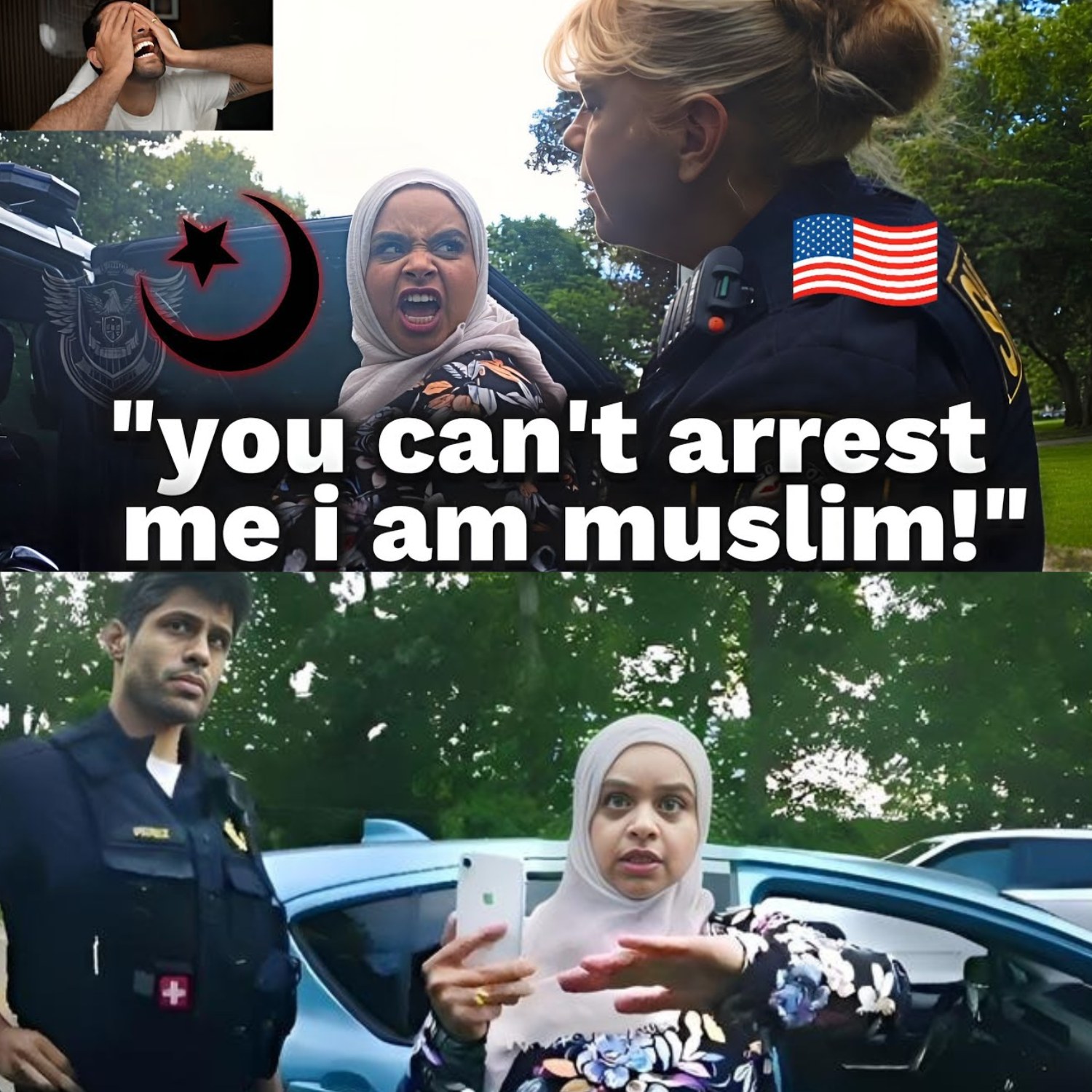
It started with a scream in the back of a police car.
“You did your Islamophobia!”
Within hours, the clip exploded across social media platforms, triggering millions of views, furious comment wars, reaction videos, livestream debates, and endless reposts. But that dramatic confrontation was only the beginning of a much larger online firestorm now consuming the internet — one fueled by culture clashes, viral misunderstandings, emotional public outbursts, and a nation increasingly divided over identity, religion, and everyday life.
From shopping malls to amusement parks, grocery stores to city streets, a wave of controversial videos has left viewers stunned, confused, entertained, and deeply polarized. Some call it a fight for religious freedom. Others say it reflects growing tensions between modern lifestyles and strict traditional beliefs.
Either way, one thing is undeniable:
America cannot stop watching.
As officers calmly ask her to shift positions for safety procedures, the woman loudly claims she is being targeted because of her religion.
“You know I’m Muslim!” she shouts repeatedly.
The scene quickly escalates into a confusing whirlwind of accusations, emotional outbursts, and tense exchanges as officers continue attempting to process the arrest.
“AMERICA IS CHANGING” — THE INTERNET ERUPTS
As the police footage spread, creators across social media began compiling clips featuring Muslim influencers documenting the challenges of practicing their faith in everyday American life.
One viral creator demonstrated how she navigates public restrooms while following religious cleanliness customs. Another described the difficulties of attending amusement parks while wearing a hijab and face veil.
The videos, intended by their creators to educate and share personal experiences, instead triggered fierce backlash online.
Critics mocked the restrictions described in the clips, while supporters praised the women for openly discussing the realities of balancing faith and modern society.
In one particularly viral moment, a woman explained why she avoids certain roller coasters and carnival games.
“Sounds exhausting,” one commenter wrote.
Another replied: “Or maybe it’s called commitment.”
Millions watched.
Millions argued.
And suddenly, what began as isolated videos transformed into a full-scale cultural battleground dominating timelines everywhere.
THE GROCERY STORE VIDEO THAT LEFT PEOPLE STUNNED
Then came the supermarket clip.
A young woman jokingly complained online that frozen chicken and turkey products cost more than pork products, sarcastically calling the pricing “Islamophobic.”
The short video was clearly intended as humor — but the internet did not treat it lightly.
Critics accused her of trivializing discrimination.
Supporters claimed people were overreacting to obvious satire.
Reaction videos flooded social media within hours, with creators debating whether the term “Islamophobia” itself is overused, misunderstood, or unfairly dismissed.
The clip sparked heated conversations about language, victimhood culture, and how social media amplifies outrage faster than ever before.
And still, the viral train kept moving.
INSIDE THE RISE OF “RELIGIOUS LIFESTYLE CONTENT”
Behind the controversy lies a booming online trend that experts are calling “religious lifestyle content.”
Across TikTok, Instagram, and YouTube, creators from various faith backgrounds are documenting how their beliefs influence daily routines — from food choices and fashion to relationships, entertainment, and travel.
For many viewers, the content is fascinating.
For others, it feels deeply alienating.
Some clips receive praise for promoting understanding and diversity. Others become lightning rods for ridicule and hostility.
The more emotional the reactions become, the faster the algorithms spread them.
And that creates the perfect recipe for viral chaos.
THE AMUSEMENT PARK VIDEO EVERYONE IS TALKING ABOUT
One creator’s amusement park vlog became one of the most discussed clips online this week.
In the video, the woman explains the challenges she faces while trying to enjoy rides while maintaining modest clothing standards.
She discusses concerns about wind blowing off her hijab, difficulties with ride restraints while wearing dresses, and discomfort sitting beside unrelated men on rides.
The comments section instantly became a war zone.
Some viewers empathized with her attempts to balance faith and fun.
Others argued the restrictions sounded oppressive and joyless.
“You can’t even eat ice cream?” one shocked viewer commented.
Another fired back: “People respect vegan diets and allergies. Why not religious boundaries too?”
The internet offered no consensus — only more arguments.
THE CLIP FROM A SCHOOL EVENT THAT TRIGGERED A NEW ROUND OF DEBATE
A separate viral video filmed at a school event added even more fuel to the fire.
The footage showed children participating in a cultural dance performance inspired by Middle Eastern traditions. While many viewers celebrated the event as harmless cultural appreciation, critics questioned whether schools were crossing lines between education and religious influence.
Comment sections erupted instantly.
Some parents praised multicultural exposure.
Others accused schools of promoting one culture too heavily.
As usual, outrage spread faster than facts.
THE MASSIVE COMMUNITY PROJECT RAISING EYEBROWS
Meanwhile, online discussions intensified after promotional footage surfaced for a massive planned residential development centered around Islamic culture and community life.
The project features homes, schools, businesses, community centers, and a mosque integrated into one master-planned neighborhood.
Supporters describe it as a peaceful faith-centered community designed for families seeking shared values and cultural familiarity.
Critics online, however, reacted with suspicion and fear, warning about social separation and cultural isolation.
Real estate analysts say faith-centered communities are not unusual in America. Similar developments have long existed for various religious and cultural groups.
But on social media, nuance rarely survives.
The promotional video quickly became another flashpoint in the broader online culture war.
SOCIAL MEDIA’S NEW FAVORITE SPORT: OUTRAGE
Experts say the real story may not be religion at all.
It may be the internet itself.
Modern platforms reward emotional reactions above everything else. The more shocking, offensive, emotional, or controversial a clip appears, the more aggressively algorithms push it into public feeds.
A calm discussion rarely goes viral.
A screaming confrontation does.
A nuanced conversation gets ignored.
A dramatic accusation spreads globally overnight.
In today’s digital battlefield, outrage is currency.
And everyone is cashing in.
CONTENT CREATORS ARE PROFITING FROM THE CHAOS
Behind many viral reaction videos lies a booming economy of clicks, views, donations, memberships, sponsorships, and subscriptions.
Creators on all sides are benefiting financially from controversy.
Some position themselves as defenders of religious freedom.
Others brand themselves as anti-“victim culture” commentators.
Every reaction creates another reaction.
Every controversy generates another livestream.
Every argument becomes another monetized video.
And audiences keep consuming it.
FEAR, IDENTITY, AND THE FUTURE OF AMERICA’S CULTURE CLASHES
Beneath the memes and shouting matches lies a deeper reality: many Americans are struggling to understand how vastly different lifestyles, traditions, and beliefs can coexist in an increasingly connected society.
Some fear cultural change.
Others fear intolerance.
Some feel misunderstood.
Others feel silenced.
Social media magnifies every emotion until ordinary disagreements appear like national emergencies.
And with every viral clip, the divisions seem to grow sharper.
ONE THING IS CERTAIN: THIS STORY IS FAR FROM OVER
Whether people view these videos as educational, offensive, entertaining, manipulative, or alarming, they have undeniably captured the nation’s attention.
The internet remains obsessed.
New clips continue surfacing daily.
Reaction channels continue exploding.
Comment wars rage nonstop.
And somewhere, another smartphone camera is already recording the next viral cultural collision waiting to ignite the timeline all over again.
Because in modern America, controversy is no longer confined to television studios or newspaper headlines.
Now it lives in parking lots.
In malls.
In classrooms.
In grocery stores.
And most of all —
inside the endless scroll of social media, where outrage never sleeps.