Muslims Have No Idea What They Just Unleashed in The West!!
Muslims Have No Idea What They Just Unleashed in The West!!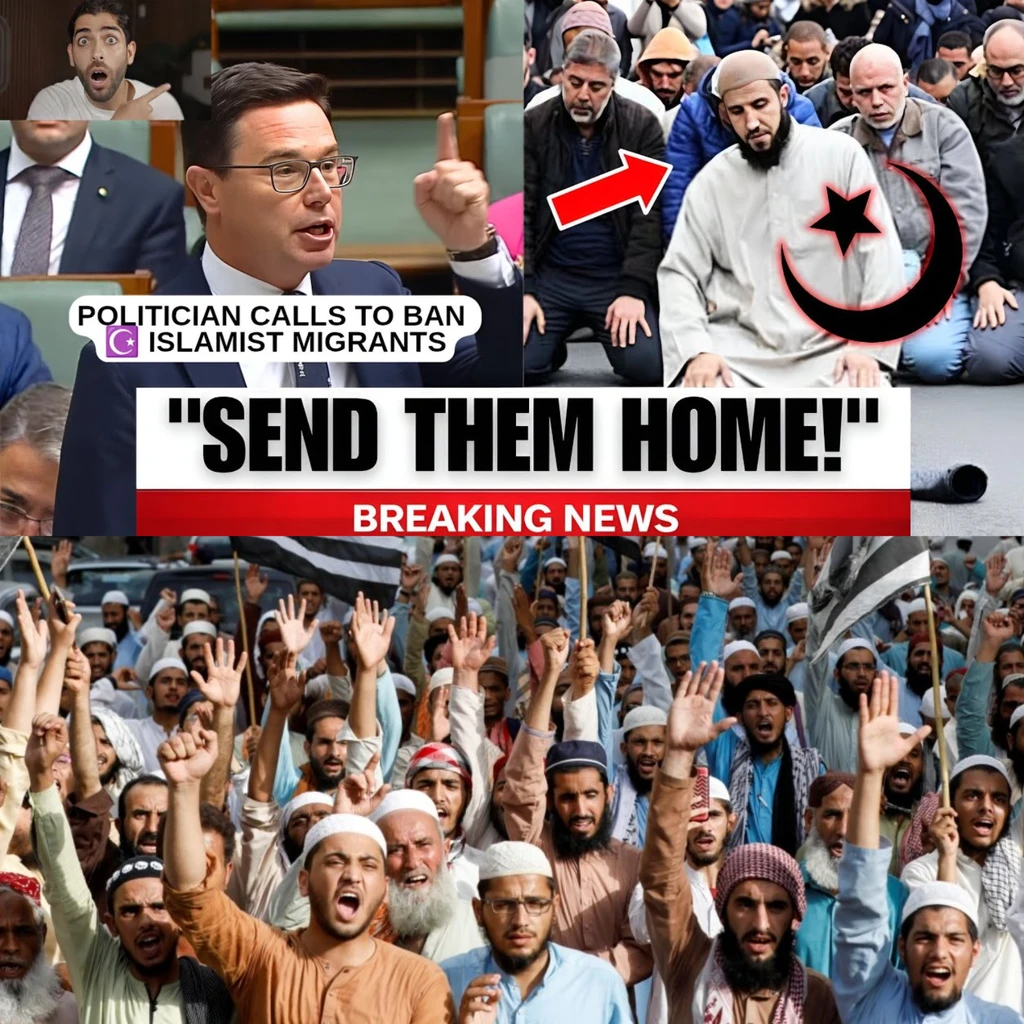
SHOCK CLAIMS, FEAR, AND CONTROVERSY ERUPT OVER ALLEGATIONS OF “PARALLEL COMMUNITIES” AND EXPANDING RELIGIOUS ENCLAVES IN AMERICAN SUBURBS
It started with a speech.
Not a breaking news alert, not a protest, not an incident—but a public address delivered with urgency, warning, and sweeping claims that instantly ignited debate far beyond the chamber where it was spoken.
Within hours, clips of the remarks had spread across social media platforms, amplified by commentary channels, reaction videos, and heated discussions that quickly blurred the line between concern, speculation, and outright alarm.
At the center of the controversy: allegations that tightly organized religious communities were forming concentrated residential clusters in suburban regions of the United States, raising questions—some grounded in documented development disputes, others heavily disputed—about separation, integration, and the future of pluralistic neighborhoods.
One of the most frequently cited locations in the debate is the suburban corridor of Plano, part of the broader Dallas–Fort Worth metropolitan region, where a long-developing residential and institutional project tied to a local faith-based organization has drawn attention from residents, officials, and advocacy groups.
A SPEECH THAT SPARKED A DIGITAL FIRESTORM
The controversy escalated after a public address described what was characterized as a “self-contained enclave” centered around religious institutions, residential housing developments, schools, and business networks.
The speech painted a picture of a highly structured community model, one that included:
Clusters of residential housing
A central house of worship
Private educational institutions
Faith-based financial services
Health and community facilities
The speaker framed these developments as part of a broader concern over “parallel societies,” arguing that such concentrated communities may reduce cultural integration into surrounding neighborhoods.
The remarks, however, quickly drew criticism from legal experts, urban planners, and civil rights advocates who emphasized that faith-based community development is neither unusual nor inherently isolating in diverse metropolitan areas.
THE PROJECT AT THE CENTER OF THE DEBATE
At the heart of the discussion is a long-running housing and development initiative associated with a local organization and its affiliated community infrastructure.
The project includes residential lots, planned expansions, and adjacent institutional facilities such as schools and places of worship. Developers have repeatedly submitted revised plans after regulatory reviews, while local authorities have raised questions regarding zoning compliance, infrastructure planning, and documentation requirements.
Officials have also reviewed utility district proposals and land-use classifications, resulting in legal and administrative delays. Despite this, development activity and planning applications have continued over several years.
Supporters describe the initiative as a community-centered development designed to provide housing, education, and services aligned with cultural and religious needs.
Critics argue it raises concerns about exclusivity and social segmentation, particularly when residential eligibility appears to be closely tied to participation in affiliated institutions.
CLAIMS OF “FORTRESS DESIGN” AND SECURITY CONCERNS
Among the most controversial assertions circulating online are claims that certain residential structures within the development appear strategically positioned near sensitive infrastructure, including emergency facilities and law enforcement training areas.
These claims have been amplified through social media commentary and independent analysis videos, often highlighting architectural features such as elevated platforms or line-of-sight vantage points.
However, urban planning experts caution that such interpretations can be misleading without formal architectural intent evidence, noting that mixed-use development layouts often naturally include elevated structures, viewing areas, and proximity overlaps in dense suburban planning zones.
No verified findings from engineering or security agencies have publicly confirmed any malicious intent behind the design choices.
LAW ENFORCEMENT AND LEGAL CONTEXT
The broader region of Collin County has been involved in ongoing administrative reviews related to zoning compliance, utility districts, and development regulations connected to the project.
Legal proceedings have included temporary injunctions, planning re-evaluations, and regulatory oversight from multiple agencies responsible for housing standards, environmental compliance, and fair housing law enforcement.
Federal housing authorities have also reviewed aspects of the development under civil rights and housing access frameworks, examining whether any policies violate anti-discrimination statutes or improperly restrict residency based on religious affiliation.
At the same time, supporters of the project argue that private community membership requirements are not uncommon in religiously affiliated housing developments, and that participation criteria do not necessarily equate to unlawful exclusion.
THE BROADER DEBATE: INTEGRATION VS. ISOLATION
What has transformed a local planning dispute into a national conversation is not just the development itself—but the interpretation of what it represents.
To some commentators, the rise of concentrated cultural or religious housing clusters reflects a natural expression of identity preservation in diverse societies.
To others, it signals the emergence of parallel social systems that could reduce shared civic participation.
Urban sociologists note that similar patterns have existed in many forms across American history, including ethnic neighborhoods, religious enclaves, and immigrant settlement corridors—often eventually integrating more fully over time.
The difference in this case, critics argue, lies in the perceived institutional structure of the community model, where residential, educational, and financial systems are tightly interconnected.
THE ONLINE AMPLIFICATION EFFECT
As clips of speeches and testimony circulated online, commentary ecosystems rapidly intensified the narrative.
Short-form videos, reaction streams, and political commentary channels dissected every claim, often removing context and amplifying emotionally charged segments.
Some videos framed the developments as existential cultural threats, while others pushed back, labeling the discourse as misinformation or fear-driven interpretation of ordinary zoning activity.
The result has been a deeply polarized information environment in which the same set of facts is interpreted in radically different ways depending on ideological lens.
EXPERTS URGE CAUTION AMID ESCALATING RHETORIC
Legal analysts and urban policy experts caution that the language used in public discourse has begun to outpace verified evidence.
They emphasize that:
Residential clustering is common in many faith-based and cultural communities
Zoning disputes are routine in fast-growing suburban regions
No verified evidence supports claims of coordinated “security threats” linked to architectural design
Allegations circulating online often rely on speculation rather than documented findings
At the same time, they acknowledge that concerns about social cohesion and integration are legitimate policy discussions when approached through data rather than rhetoric.
A COMMUNITY UNDER A MICROSCOPE
For residents in the region, the debate has brought unexpected national attention to what was once a local development issue.
Some community members describe frustration at being portrayed through sweeping generalizations, emphasizing that the area is composed of ordinary families, small businesses, and religious institutions coexisting within standard suburban infrastructure.
Others express concern that misinformation circulating online has made everyday life feel politicized and scrutinized in ways disconnected from their lived experience.
THE FINAL QUESTION EMERGING FROM THE CONTROVERSY
As the discourse continues to spread across media platforms, one question remains unresolved:
Where is the line between legitimate concern about social integration—and exaggerated narratives shaped by fear, speculation, and viral amplification?
The answer may depend less on any single development in Plano or Collin County, and more on how societies choose to interpret the evolving nature of modern suburban diversity.
Because beneath the headlines, the speeches, and the viral clips, a deeper tension persists—one that is not new, but increasingly visible:
How do communities balance cultural identity with shared civic space in an era where every local development can become a national controversy overnight?
And in that question, the debate is far from over.